




The Fiery Gauntlet of Re-entry
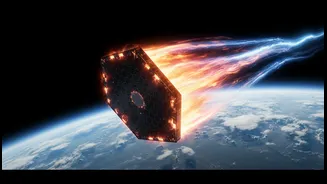
When a spacecraft enters the atmosphere, it isn't the friction that generates most of the heat, as commonly believed. Instead, the vehicle's incredible speed—often more than 28,000 kilometres per hour—massively compresses the air in front of it. This
compression creates a shockwave of plasma, a superheated gas where molecules are ripped apart. Temperatures can soar to several thousand degrees Celsius, far hotter than the melting point of any structural metal. To survive this ordeal, spacecraft rely on a Thermal Protection System (TPS), more commonly known as a heat shield. This shield is not just a passive insulator; it is an active system designed to manage and shed an immense thermal load, ensuring the vehicle and its precious cargo, whether human or robotic, remain safe within.
Ablation: A Material That Sacrifices Itself
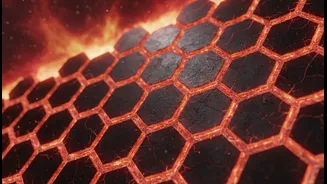
Many of the most robust heat shields use a process called ablation. An ablative shield is made from a composite material, often a resin embedded with fibres like carbon or fibreglass. As this material is exposed to extreme heat, its surface layer doesn't just melt; it chars and vaporises in a controlled chemical reaction. This process, known as pyrolysis, absorbs a vast amount of heat energy. Furthermore, the gases produced by the vaporising material form a boundary layer that pushes the searing plasma away from the spacecraft's surface, further reducing heat transfer. In essence, the heat shield sacrifices itself, layer by layer, carrying the destructive heat away with the lost mass. This principle has been used since the earliest days of spaceflight, including the Apollo missions.
Forging Spacecraft Hell on Earth
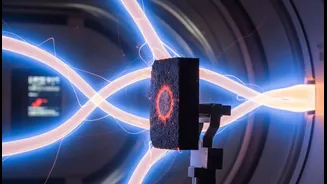
To certify that an ablative material will work in space, you must first subject it to hell on Earth. Since you can't repeatedly fly test materials into the atmosphere, space agencies like NASA and the European Space Agency (ESA) have built specialised ground facilities to simulate re-entry conditions. The most important of these are called arc jet facilities or plasma wind tunnels. At facilities like NASA's Ames Arc Jet Complex or ESA's Scirocco wind tunnel in Italy, engineers use immense amounts of electricity—sometimes up to 75 megawatts—to superheat a stream of gas. An electric arc, like a continuous bolt of lightning, heats the gas until it becomes a plasma. This plasma is then blasted through a nozzle at hypersonic speeds, creating a multi-thousand-degree flow that mimics the conditions a spacecraft faces.
The Trial by Fire
During a test, a sample of the heat shield material is placed directly into the path of this plasma jet. These tests can last from a few seconds to over half an hour, simulating different phases of atmospheric entry. A battery of sensors and high-speed cameras documents every moment of the material's ordeal. Engineers measure the temperature on both the front and back of the sample to see how well it insulates. They track the 'recession rate'—how quickly the material erodes under the intense heat and force of the plasma flow. Spectrometers analyse the light from the plasma and the burning material to understand the chemical reactions taking place. This data is crucial for validating computer models that predict how the full-scale heat shield will perform during an actual mission.
Beyond Earth: Testing for Mars and Titan
These advanced facilities are not just for testing re-entry into Earth's atmosphere. Missions to other planets require shields designed for entirely different conditions. Mars, for instance, has a very thin atmosphere composed mostly of carbon dioxide. Saturn's moon, Titan, has a thick, nitrogen-rich atmosphere. Plasma wind tunnels can be configured to use different gas mixtures to simulate these alien environments. By re-creating the specific pressures, temperatures, and chemical compositions of other worlds, engineers can design and qualify the unique heat shields needed for landers like NASA's Dragonfly mission to Titan or future Mars sample return missions. This capability is vital for pushing the boundaries of solar system exploration, ensuring probes can safely land and conduct their science.