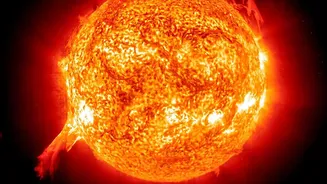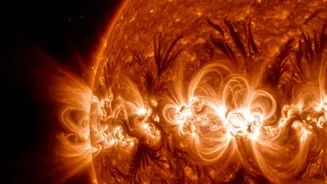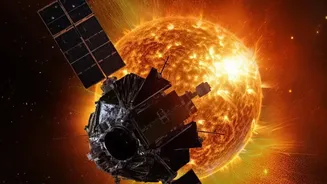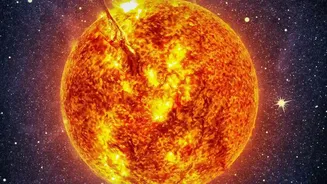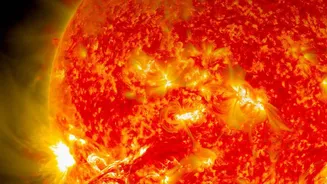




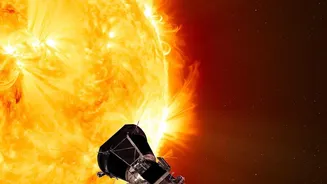
In a remarkable display of international space collaboration, India's Aditya-L1 solar observatory is teaming up with Europe's Proba-3 mission. Together, they are providing a revolutionary new look at the Sun's most violent eruptions.
India's Vigilant Eye: Aditya-L1
Launched by ISRO in
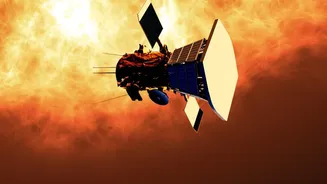
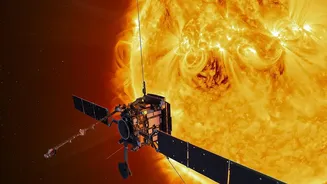
September 2023, Aditya-L1 is India's first dedicated mission to study the Sun. It is strategically positioned at Lagrange Point 1 (L1), a stable point 1.5 million kilometres from Earth, where it has an uninterrupted view of our star. The spacecraft is equipped with seven advanced instruments designed to observe the Sun's atmosphere—the photosphere, chromosphere, and the outermost corona. The key player in this new collaboration is the Visible Emission Line Coronagraph (VELC). A coronagraph is an instrument that blocks the blindingly bright light from the Sun's main disk, allowing scientists to study the much fainter corona. VELC is special because it performs spectroscopy, analysing the light to determine the temperature, velocity, and density of the coronal plasma.
Europe's Artificial Eclipse: Proba-3
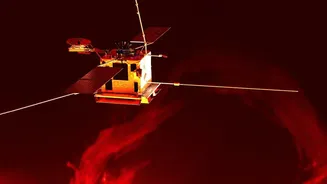
The European Space Agency's (ESA) Proba-3 mission, interestingly launched by an ISRO PSLV rocket in December 2024, is an engineering marvel. It consists of two spacecraft flying in precise formation, about 150 metres apart. One spacecraft, the 'Occulter', positions itself to block the Sun's disk, casting a precise shadow over the second spacecraft, the 'Coronagraph'. This creates a sustained artificial solar eclipse lasting for hours at a time. This innovative technique allows Proba-3's coronagraph, ASPIICS, to capture incredibly sharp images of the inner corona, a region notoriously difficult to observe. By getting much closer to the Sun's edge than traditional single-spacecraft coronagraphs, Proba-3 gives scientists a clearer view of where solar eruptions originate.
A Powerful Combination
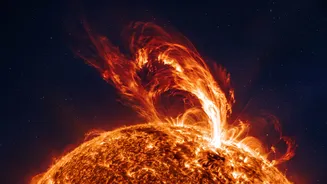
The synergy between Aditya-L1 and Proba-3 offers a more complete picture than either mission could achieve alone. While Proba-3's ASPIICS provides sharp, high-resolution images of a solar eruption's shape and structure, Aditya-L1's VELC provides spectroscopic data on the eruption's physical properties, like its speed, density, and thermal energy. Researchers at the Indian Institute of Astrophysics (IIA) recently combined data from both missions to study two Coronal Mass Ejections (CMEs) that occurred in September 2025. One CME was fast, travelling at about 645 km per second, while the other was much slower at 145 km per second. By cross-checking the imaging data from Proba-3 with the physical measurements from Aditya-L1, scientists could build a more accurate and detailed model of how these eruptions evolve just after leaving the Sun.
Why This Research Matters
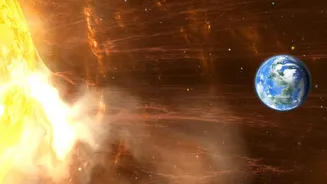
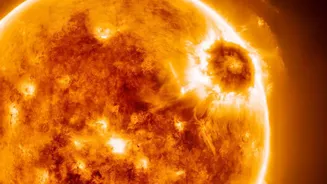
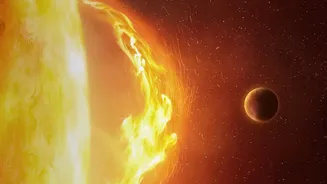
Coronal Mass Ejections are massive explosions of plasma and magnetic fields from the Sun. While many miss our planet, those directed towards Earth can trigger geomagnetic storms. These storms can have significant consequences, disrupting satellite operations, scrambling GPS navigation, causing radio blackouts, and even damaging power grids on the ground. Understanding the early evolution of CMEs—how they accelerate and gain energy—is crucial for improving space weather forecasting. Better forecasts give operators more time to protect vulnerable satellites and terrestrial infrastructure. This joint observation campaign, providing unprecedented detail on CMEs near the Sun, is a major step toward that goal.