








The End of an Era for IGI's Monopoly
For years, Delhi’s Indira Gandhi International (IGI) Airport has been the undisputed gateway to North India. As one of the world's top 10 busiest airports, it has handled staggering passenger numbers, growing to a capacity of over 100 million passengers
per year. However, this growth has come with immense pressure. Peak-hour congestion, both in the air and on the roads leading to it, has become a familiar headache for travellers. Boxed in by the city's urban sprawl, IGI's physical expansion has reached its practical limits. This capacity crunch created the need for a second major airport, not just to handle overflow, but to fundamentally rebalance air traffic across the vast National Capital Region.
Enter Noida International Airport (Jewar)
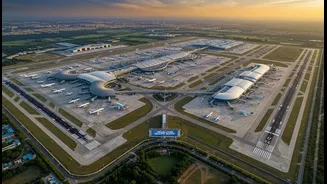
The long-awaited answer to NCR's aviation needs, Noida International Airport (NIA), located at Jewar, officially began commercial passenger operations on June 15, 2026. With the airport code DXN, it represents a new centre of gravity for air travel, particularly for the nearly 35 million residents of East Delhi, Noida, Greater Noida, Ghaziabad, and Western Uttar Pradesh. For this massive population, the gruelling two-hour cross-city commute to IGI is being replaced by a more direct journey via the Yamuna Expressway. Phase 1 of the airport is designed to handle 12 million passengers annually, with IndiGo, Akasa Air, and Air India Express as the initial carriers focusing on domestic routes. Though starting on a smaller scale than IGI, Jewar is designed for massive future expansion, with plans to eventually handle up to 70 million passengers per year.
Location, Location, Location: A New Calculation for Travellers
The biggest change for NCR residents is the new decision-making process before booking a flight. Your home address now dictates your ideal airport. For those in South Delhi, Gurugram, and West Delhi, IGI remains the more convenient option. But for anyone in Noida, Greater Noida, or along the Yamuna Expressway corridor, Jewar is a game-changer, cutting travel time significantly. For instance, a trip from Greater Noida to IGI can take up to two hours, while the journey to Jewar is a more predictable 45-60 minutes. This geographic split means airlines will likely tailor their services. While IGI remains the dominant hub for international and high-frequency business routes, Jewar is positioning itself as a convenient alternative for domestic travel and a potential hub for tourists heading to Agra and the 'Golden Triangle'.
Hindon Airport: The Regional Player
The NCR airport map isn't just a two-player game. Hindon Airport (HDX) in Ghaziabad continues to serve as a civil enclave, focusing on regional connectivity under the UDAN scheme. While its operations are smaller—the summer 2026 schedule features eight routes to cities like Bengaluru, Kolkata, and Varanasi—it provides a crucial, closer option for residents in Ghaziabad and parts of East Delhi. However, Hindon faces its own challenges with infrastructure constraints, limited parking bays, and a recent reduction in flights after Air India Express ceased its operations there, partly citing the launch of Noida Airport as a factor. Authorities are planning upgrades, including night operations, to better utilize its prime location.
The Future: A Connected Multi-Airport System
The long-term vision is an integrated multi-modal transport system connecting all three airports. Ambitious plans are underway for a Namo Bharat (RRTS) corridor to link Ghaziabad with Jewar Airport in about 40-50 minutes. There are also proposals for a bullet train corridor that could connect Jewar to IGI in approximately 21 minutes, although these projects are still in the planning stages. For now, ground connectivity to Jewar relies on the Yamuna Expressway, with bus services and app-based cabs still scaling up. Travellers are advised to plan their journeys carefully, keeping extra time for the commute until public transport options become more robust and predictable. The lower VAT on aviation fuel in Uttar Pradesh compared to Delhi could also incentivise airlines to shift more operations to Jewar over time, potentially impacting flight availability and pricing.