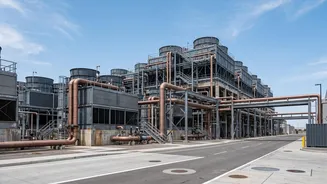








The digital world feels weightless, but the infrastructure powering it has a colossal physical footprint. In the US, the largest data centres now consume so much electricity that their carbon emissions rival those of an entire European nation.
The Invisible Engine of Modern Life
Every email
you send, photo you post, show you stream, or question you ask an AI assistant passes through a data centre. These vast, windowless buildings are the factories of the digital age, housing tens of thousands of computer servers that run 24/7. They are the physical backbone of our increasingly online lives. For decades, their growth was steady, but the explosion of cloud computing and, more recently, generative artificial intelligence has triggered an unprecedented surge in demand. This has led to the rise of 'hyperscale' data centres, massive facilities that can span the area of several football fields and consume enormous amounts of power for both computing and cooling.
A Nation-Sized Carbon Footprint
The scale of this energy consumption is difficult to grasp, but a recent Harvard University study puts it in stark perspective. Researchers analyzing 403 of the largest 'hyperscale' data centres in the US between May 2024 and April 2025 found their combined carbon dioxide emissions were an estimated 25.7 million metric tons. That figure is roughly equivalent to the entire annual emissions of Denmark, a nation of nearly six million people. The study, published in Nature Sustainability, noted this is a conservative 'floor estimate', as there are now over 1,200 such facilities operating in the US, with hundreds more planned. The electricity demand alone, at 82 terawatt-hours, is comparable to that of entire US states like Michigan or Tennessee.
AI: The Great Accelerator
The primary driver behind this exponential growth is the insatiable appetite of artificial intelligence. Training and running large-scale AI models requires immense computational power, which translates directly into higher energy use. According to the International Energy Agency (IEA), global data centre electricity use is projected to double by 2030, and AI will be responsible for a significant portion of that increase. The IEA also projects that worldwide carbon emissions from data centres could rise by 70% by 2030 as a result. This is because the rapid expansion is outstripping the supply of clean energy, forcing developers to rely more heavily on fossil fuels. In the US, the IEA projects that natural gas could supply about 60% of electricity for data centres by the end of the decade.
Straining Grids and Green Goals
This surge in demand poses a dual threat. Firstly, it puts immense strain on national and regional power grids, some of which are already aging. In major data centre hubs like Northern Virginia, the wait time for a new grid connection can be several years, forcing some companies to consider building their own on-site gas-powered generation. This creates a second, more significant problem: it jeopardizes the climate goals of both the tech industry and the country. Despite major investments in renewable energy, many top tech companies are finding their overall emissions are rising, not falling, because their energy consumption is growing so quickly. The Harvard study found that over half the electricity powering the data centres it analyzed came from fossil fuels.
The Search for Sustainable Solutions
The challenge has sparked a race for solutions. One key factor is geography; a data centre's carbon footprint is heavily dependent on the local energy mix. For instance, the same amount of electricity generates far more carbon in a coal-reliant state than in one with significant hydropower. Tech companies are also exploring more efficient cooling technologies, as keeping servers from overheating is a major energy drain. Some are even looking at ways to capture and reuse the vast amounts of waste heat generated by these facilities for local heating systems. However, without greater transparency from companies and stronger regulations on emissions and energy sources, the true environmental cost of our digital lives will continue to grow unchecked.