



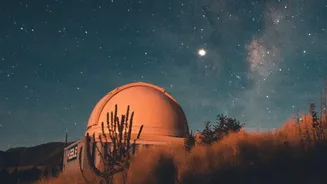

Your Pocket Planetarium
For generations, navigating the night sky required star charts, a deep knowledge of constellations, and skies free from light pollution. Today, all you need is the phone in your pocket. Modern stargazing apps use your device’s built-in GPS and compass
to know your exact location and the direction you’re pointing. When you hold your phone up to the sky, these apps use augmented reality (AR) to overlay a detailed map on your screen. Suddenly, anonymous points of light are given names, constellations are traced with helpful lines, and planets are clearly labelled, turning a confusing starscape into an interactive guide.
Three Apps to Get You Started
Diving into the world of astronomy apps can be overwhelming, but a few stand out for their user-friendly design, making them perfect for beginners. Star Walk 2 is a popular choice, praised for its beautiful visuals and easy-to-use AR features that help you identify celestial bodies in real-time. SkyView Lite is another excellent free option that excels at using AR to pinpoint planets, stars, and even satellites like the International Space Station. For those who appreciate realism, Stellarium Mobile offers a clean interface and a highly accurate depiction of the night sky, inheriting the power of its renowned desktop software. Many of these apps work offline, making them perfect companions even when you're away from a stable internet connection.
Spotting the Gas Giants This September
Jupiter and Saturn are fantastic targets for urban stargazers because their brightness allows them to cut through the haze of city lights. They don’t twinkle like distant stars; instead, they shine with a steady, serene light. During September 2026, you can spot both, but you’ll have to time it right. Saturn, appearing as a yellowish point of light, rises in the east shortly after sunset and will be visible for most of the night. It's often the only bright object in the southeastern sky around 10 p.m. Jupiter, on the other hand, is the star of the pre-dawn show. Look for a brilliant, white light dominating the eastern sky a few hours before sunrise. As the month progresses, it will rise earlier, giving you more time to view it against a truly dark sky.
Best Practices for Balcony Astronomy
To get the most out of your urban stargazing session, a few simple tricks can make a world of difference. First, find the darkest part of your balcony or rooftop, away from the direct glare of streetlights or neighbouring windows. Turn off your own lights and give your eyes at least 15 to 20 minutes to adjust to the darkness; this will dramatically increase your ability to see fainter objects. When using your app, switch to its 'night mode,' which uses a red filter to preserve your night vision. While your eyes are all you need to spot the planets, a simple pair of binoculars can elevate the experience, possibly revealing the four largest moons of Jupiter or the elongated shape of Saturn caused by its magnificent rings.