









The Old Ladder: Learning by Doing
For decades, the path to professional mastery was clear. You started at the bottom. A junior software engineer would spend months on bug fixes and basic coding. A new marketing associate would draft endless social media posts and compile performance reports.
A first-year law associate would drown in document review. These tasks were often repetitive and foundational. While not glamorous, they served a critical purpose: they were the lower rungs of a career ladder, teaching newcomers the core mechanics of their profession through hands-on experience before they moved on to more complex, strategic work.
The AI Apprentice Has Arrived
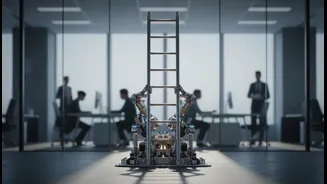
Now, generative AI is taking over many of those foundational tasks. AI tools can draft and debug code, generate marketing copy, summarize lengthy reports, and analyze data sets in minutes. The very work that once served as a professional apprenticeship is being automated. This isn't a future prediction; it's happening now. Research shows that entry-level job postings have seen a significant decline in large part due to AI. The paradox for companies is that they still need experienced talent, but the primary pathway for creating that talent is eroding. The first rung of the ladder has been raised, if not removed entirely.
The Experience Paradox
This creates a challenging situation for new entrants into the workforce. Employers now expect junior workers to have skills that the junior roles themselves no longer teach. Postings for entry-level jobs in AI-exposed sectors are increasingly demanding senior-level skills like strategic thinking, leadership, and complex judgment from day one. How can a new graduate be expected to supervise or evaluate an AI's output before they've mastered the underlying task themselves? This creates a skills gap where foundational knowledge is assumed but no longer built through traditional on-the-job training. The result is a workforce where climbing the ladder requires new tools and a different approach.
Building a New Ladder
Forward-thinking companies are recognizing this shift and are beginning to reinvent their approach to talent development. If AI is the new apprentice, human roles must evolve. The focus is shifting from teaching task execution to cultivating oversight and judgment. Onboarding processes are being redesigned to be more personalized and efficient using AI tools to handle administrative work, freeing up HR teams to focus on meaningful integration. Training is becoming more deliberate, using simulations, structured mentorship, and projects that force new hires to work alongside AI, not just delegate to it. The goal is to accelerate the development of uniquely human skills: critical thinking, creativity, ethical judgment, and collaboration.
What This Means for India's Workforce
For a nation like India with a vast young population entering the job market, this transformation is especially critical. The emphasis must shift from rote learning to developing AI fluency and higher-order thinking skills right from the start. Professionals should focus on becoming adept at asking the right questions, managing AI tools effectively, and understanding their domain so deeply that they can guide the technology strategically. For managers, the challenge is to move from being taskmasters to coaches who can nurture judgment in a team of human and AI contributors. Reskilling and upskilling are no longer just buzzwords but essential business imperatives for survival and growth.