



Why Sitting Wrecks Your Hips
Our bodies are designed for movement, but many of us spend a significant portion of the day in a chair. When you sit for extended periods, the muscles at the front of your hips, known as the hip flexors, remain in a shortened position. Over time, this
can cause them to become tight and stiff. Simultaneously, the gluteal muscles in your buttocks become inactive and weaken from lack of use. This combination of tight flexors and weak glutes creates an imbalance that can restrict your range of motion, lead to poor posture, and even contribute to lower back pain as the spine tries to compensate for the lack of hip mobility. Studies have shown a direct link between prolonged sitting and reduced hip extension, highlighting how our daily habits can physically change our bodies.
Kneeling Hip Flexor Stretch
This is often considered the gold standard for targeting tight hip flexors. Start by kneeling on one knee, perhaps with a cushion underneath for comfort. Place your other foot flat on the floor in front of you, creating 90-degree angles at both knees. Gently tuck your pelvis—imagine pulling your belt buckle up toward your chin—and squeeze the glute of the kneeling leg. You should feel a stretch in the front of that hip. Hold this position for 30 to 60 seconds, breathing deeply, and then switch sides. Avoid arching your lower back; the movement should be a small, controlled forward shift.
Seated Figure-Four Stretch
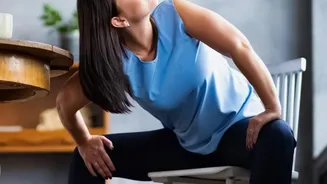
A perfect stretch you can do right from your chair. Sit upright and cross your right ankle over your left knee, allowing your right knee to drop out to the side. Your legs should form a 'figure four' shape. To deepen the stretch, gently hinge forward at your hips, keeping your back straight, until you feel a pull in your right glute and outer hip. It is important to keep your foot flexed to protect the knee joint. This is an excellent way to target the deep rotator muscles that often become tight from sitting. Hold for about 30 seconds before repeating on the other side.
Butterfly Stretch
The inner thigh muscles, or adductors, also get tight from being held in a fixed position while sitting. The butterfly stretch helps to open them up. Sit on the floor and bring the soles of your feet together, letting your knees fall out to the sides. Hold onto your ankles or feet and sit up tall, trying to keep your hips grounded. You can gently press your knees toward the floor for a deeper stretch, but do not force it. This should be a gentle release, not a painful strain. Hold the position for 20 to 30 seconds while maintaining relaxed breathing.
Glute Bridge
This exercise helps to 'wake up' and strengthen the glute muscles that become inactive during long periods of sitting. Lie on your back with your knees bent, feet flat on the floor about hip-width apart, and your arms by your sides. Squeeze your glutes and lift your hips off the floor until your body forms a straight line from your shoulders to your knees. Hold at the top for a few seconds, focusing on the contraction in your glutes, then slowly lower your hips back down. Repeat this 10 to 15 times. This move not only strengthens your glutes but also encourages hip extension.
90/90 Hip Switch
This dynamic stretch is excellent for improving both internal and external rotation of the hips. Sit on the floor with both knees bent at 90 degrees. One leg should be in front of you with the shin parallel to your body, and the other leg should be out to the side. Keeping your feet in place as much as possible, slowly rotate your hips to switch the position of your legs to the opposite side. The movement should be smooth and controlled. This exercise helps to warm up the hip joints and improve their overall rotational capacity. Repeat for several repetitions, flowing from side to side.