




Look up this October for a celestial treat. The Moon will cozy up to Jupiter, the largest planet in our solar system, in a beautiful night-sky pairing. Here is your complete guide to witnessing this stunning astronomical event from India.
What Is a Conjunction?
In astronomy,
when two celestial bodies appear close to one another in the sky, it's called a conjunction or a close approach. This October, a waning crescent Moon will pass near the brilliant planet Jupiter. While the most dramatic version of this event, a lunar occultation where the Moon completely hides Jupiter, will be visible elsewhere, viewers in India will still be treated to a stunningly close pairing. The two objects are, of course, millions of kilometres apart, but from our vantage point on Earth, they will appear as neighbours in the pre-dawn sky, offering a beautiful sight for early risers.
The Key Date and Time
The main event for viewers in India occurs in the early morning hours of Tuesday, October 6, 2026. You will need to look up before sunrise to catch the show. A slim, waning crescent Moon will be visible, making the bright light of Jupiter stand out even more. The night before, on October 5, Mars will also make a close approach to the Moon, giving you two consecutive nights of planetary pairings to enjoy in the early morning sky.
How to Find the Celestial Pair
Finding the Moon and Jupiter will be straightforward. On the morning of October 6, simply look towards the eastern sky before sunrise. Jupiter shines with a bright, steady light, unlike stars which tend to twinkle. It will be one of the brightest objects in that part of the sky, making it easy to identify. The slender crescent Moon will be situated very close by, creating a striking visual duo. For the best view, find a location with a clear, unobstructed view of the eastern horizon, away from tall buildings or trees.
Do You Need a Telescope?
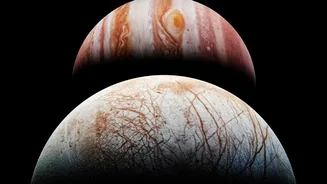
No special equipment is required to enjoy this celestial event; the pairing will be clearly visible to the naked eye. However, if you have a pair of binoculars or a small telescope, you can enhance the experience significantly. Pointing binoculars at Jupiter can reveal it as a tiny disk rather than a point of light. Even more exciting, a good pair of binoculars might allow you to spot Jupiter's four largest moons — Io, Europa, Ganymede, and Callisto — which appear as tiny, star-like dots in a line flanking the giant planet.
Tips for the Best Viewing Experience
To make the most of your stargazing session, a little preparation goes a long way. First, try to get away from city lights. Light pollution washes out fainter stars and can diminish the splendour of such events. Second, give your eyes time to adapt to the darkness. It takes about 20 to 30 minutes for your eyes to become fully sensitive to low light, revealing many more stars than are initially visible. During this time, avoid looking at your bright phone screen, which can reset your night vision. Using a stargazing app on your phone with a red-light mode can help you identify constellations without ruining your dark adaptation. Finally, even on mild nights, it can get chilly when you're sitting still, so bring a jacket and perhaps a blanket to stay comfortable.