




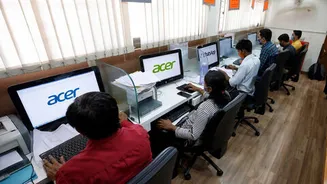
India is heading towards a major workplace paradox. Projections show its office-based workforce will swell to 48 million by 2030, yet the rise of AI is simultaneously questioning the very need for traditional office space.
A Nation of New Desks
India's economy is on a powerful
growth trajectory, and with it comes a massive expansion of its white-collar workforce. Recent industry reports, including a notable study from Cushman & Wakefield, predict that the number of office-using employees will jump from approximately 38 million in 2025 to 48 million by the end of the decade. This addition of around 1.8 million new office workers annually is driven by the relentless growth of the IT services sector and the increasing number of Global Capability Centres (GCCs) setting up shop in the country. These GCCs, which are offshore units of multinational corporations, are moving beyond basic back-office tasks and into higher-value work like R&D, product engineering, and advanced analytics, all of which require skilled professionals in an office environment. This surge in human capital naturally suggests a corresponding boom in demand for commercial real estate.
The AI Co-worker Arrives
Running parallel to this workforce growth is the rapid integration of Artificial Intelligence. Far from the sci-fi trope of replacing humans, AI in the corporate world is primarily being adopted as an augmentation tool. It is poised to handle routine, data-intensive tasks, thereby freeing up employees to focus on strategic, creative, and collaborative functions. According to a recent CBRE survey, a massive 93% of office occupiers in India are already at some stage of AI implementation. However, the immediate impact on real estate isn't what many would assume. The same survey found that 57% of these companies do not anticipate AI having a measurable impact on their leasing decisions in the near term. The consensus is that AI won't necessarily reduce headcount but will fundamentally change job roles and the skills businesses require, creating new opportunities for growth in tech-led functions.
From Cubicles to Collaboration Hubs
The true impact of AI on office space lies in reimagining its purpose. If AI can handle analytical heavy lifting, the primary function of the physical office shifts from a place for individual, siloed work to a hub for human interaction. The office of 2030 will be defined by its ability to foster collaboration, spark innovation, and build corporate culture—things that remote work struggles to replicate consistently. This is accelerating a 'flight-to-quality', where companies are no longer just seeking square footage but premium, adaptable, and well-located environments. The demand is shifting towards spaces with better amenities, advanced tech infrastructure, and designs that promote teamwork. Flexible workspaces are also becoming a key part of this strategy, with studies showing 67% of occupiers expect to include flex space in their portfolios.
The New Real Estate Equation
So, what does this mean for developers and investors? While the headline number of 48 million workers points to a massive need for office space, the reality is more nuanced. AI is influencing the 'type' of space required long before it alters the 'quantum'. Demand will centre on high-quality, green-certified buildings that can attract and retain top talent. These 'Grade A' assets are becoming crucial differentiators. While more people will be going to an office, the layout will be different, with fewer dedicated desks and more shared, activity-based zones for brainstorming, client meetings, and team projects. This might lead to a scenario where overall office demand remains strong, but vacancy rates for older, less-equipped buildings could rise. One study projects vacancy rates could peak at 16.2% in 2029 before normalising, as new, high_quality supply comes online to meet evolved demand.