



An Orchestra of Cosmic Data
For over two decades, NASA's Chandra X-ray Observatory has been our eye on the high-energy universe, revealing secrets of black holes, colliding galaxies, and stellar explosions in light our eyes can't see. But what if you could experience this invisible
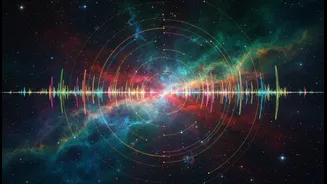
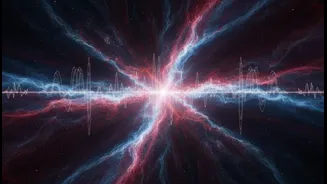
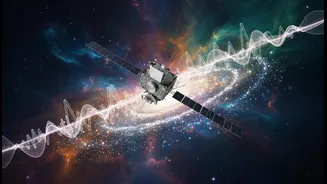
universe with your ears? A groundbreaking project led by the Chandra X-ray Center is doing just that through a process called data sonification. This initiative translates the digital data collected by telescopes into sound, assigning musical notes and tones to different properties of cosmic objects. Brightness might become volume, and position in an image can determine the pitch. The result is a celestial symphony where stars are individual notes and vast clouds of gas become an evolving drone.
Hearing the Galactic Centre
One of the most stunning examples is the sonification of the centre of our Milky Way galaxy. As a scan moves across the image, data from Chandra, along with the Hubble and Spitzer space telescopes, are transformed into an ensemble of different instruments. Chandra’s X-ray data, revealing gas heated to millions of degrees, might sound like bells or a modified piano. Meanwhile, Hubble’s view of star-forming regions is played by plucked strings, and Spitzer’s infrared data of glowing dust clouds adds a rich, sustained drone. The composition builds to a crescendo as it reaches Sagittarius A*, the supermassive black hole at the galaxy's heart, where the cosmic activity is most intense. These sonifications are not just artistic interpretations; they are data-driven compositions that offer a new way to understand astronomical phenomena.
Science You Can Touch
The mission to make science multi-sensory doesn't stop with sound. The same data used to create dazzling images and cosmic music is also being used to create 3D models of celestial objects. This allows anyone to hold a representation of a supernova remnant like Cassiopeia A or trace the complex structure of a stellar nursery with their fingertips. Visualization scientist Dr. Kimberly Arcand, a key figure behind these initiatives, has championed using 3D printing and virtual reality to make astrophysics tangible. These tactile models provide another pathway for understanding complex structures in space, breaking down barriers and making the universe feel closer than ever.
More Than Just Cool, It’s Inclusive
While turning a galaxy into a song is undeniably cool, the driving force behind these projects is accessibility. The sonification and 3D modeling initiatives were started with the blind and low-vision community in mind, offering them a direct way to experience the wonders of astronomy. By translating visual data into sound and touch, the Chandra team is ensuring that scientific discovery is not limited to those with sight. This approach, developed in collaboration with members of the blind and low-vision community, also offers new perspectives for sighted researchers, who might notice new patterns or details in the data when it's presented as sound. The project has expanded to become NASA's "Universe of Sound," a testament to its success and importance.