



A Sweet Find Near the Galactic Centre
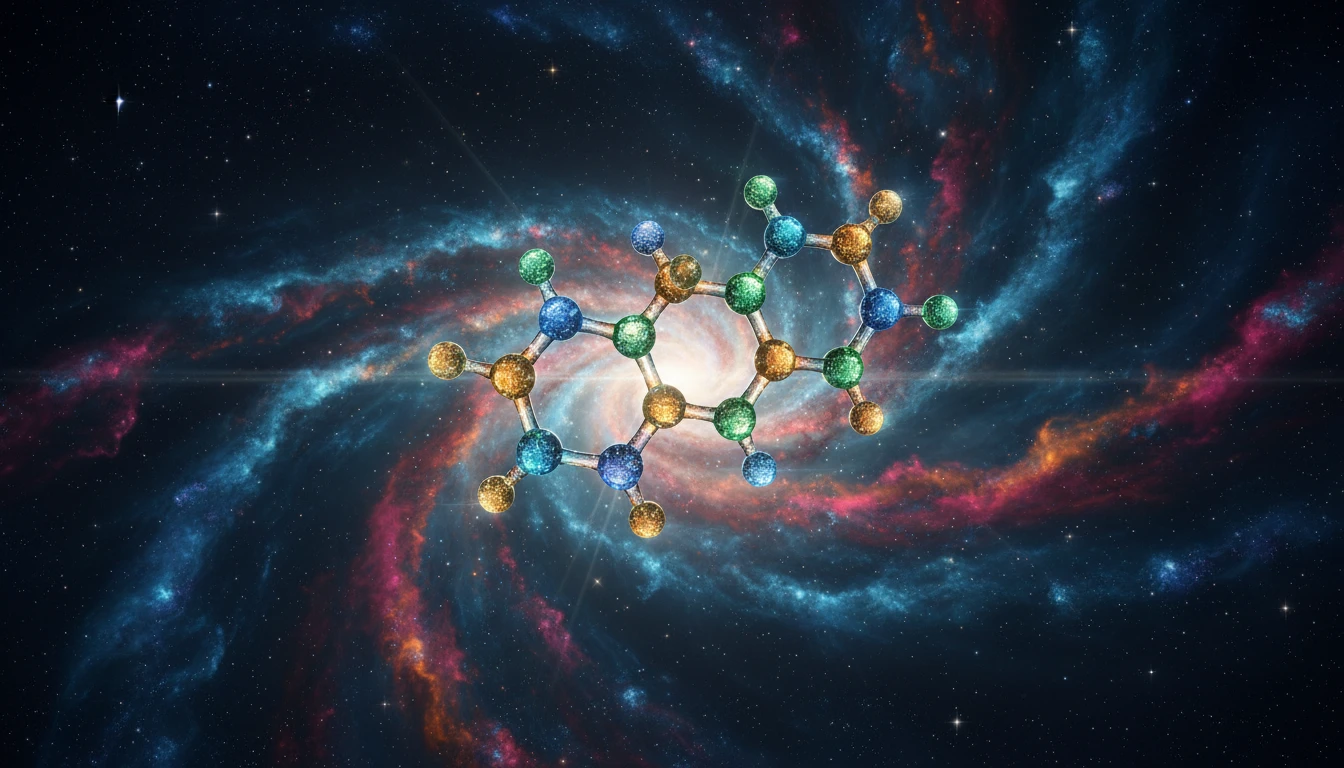
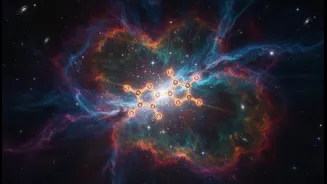
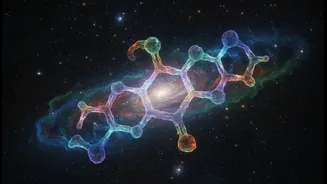
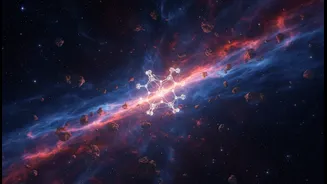
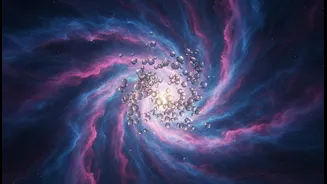
Astronomers have detected a complex sugar molecule for the first time ever in interstellar space. Using highly sensitive radio telescopes in Spain, an international team of scientists identified the chemical signature of erythrulose, a four-carbon sugar,
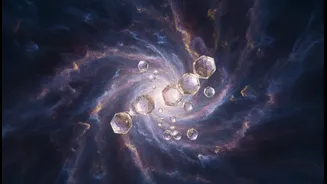
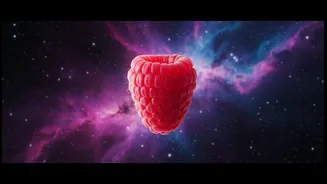
in a vast cloud of gas and dust called G+0.693-0.027. This molecular cloud, located about 27,000 light-years from Earth near the centre of the Milky Way, is a stellar nursery where new stars and planets are born. On Earth, erythrulose is a simple sugar found in raspberries. Its discovery in the cold, dark vacuum of space confirms that complex organic molecules, which are crucial for life, can form under extreme interstellar conditions.
The Cosmic Recipe for Life
Why is finding sugar in space so significant? Sugars are one of the four main families of chemicals that life depends on, alongside lipids, amino acids, and nucleic acids. Specifically, they form the backbone of RNA and DNA, the molecules that carry genetic information. For decades, a major puzzle in origin-of-life research has been how these essential sugars could have formed on early Earth, as laboratory experiments simulating those conditions have struggled to produce them in sufficient quantities. This discovery provides strong evidence for an alternative source: space. The raw ingredients for life may not have originated on our planet but could have been delivered by comets and asteroids that were enriched with these space-formed molecules.
From Molecular Cloud to Planetary Mass
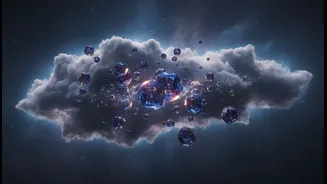
The headline's mention of "planet core materials" points to the journey these molecules take. While not ending up in the metallic core itself, this interstellar dust and gas is the raw material from which entire solar systems are built. As a molecular cloud like G+0.693-0.027 collapses to form a new star, the surrounding material flattens into a rotating disc called a protoplanetary disk. Within this disk, icy dust grains, coated with molecules like erythrulose, collide and stick together. This process of accretion builds larger and larger bodies, from pebbles to planetesimals, and eventually to full-fledged planets. These organic compounds become integrated into the planet's composition, potentially seeding its surface and early oceans with the building blocks of biology. Researchers estimate that during the Late Heavy Bombardment period, millions of tonnes of erythrulose could have been delivered to Earth.
An Unexpected Abundance
The discovery of erythrulose also challenged existing theories about how complex molecules form in space. The prevailing view was that they grow sequentially, by adding one carbon atom at a time. If this were the case, scientists would have expected to find more two- and three-carbon sugars than a four-carbon one like erythrulose. However, the survey found that erythrulose was at least eight times more abundant than similar three-carbon sugars, which weren't detected at all. This suggests a different chemical pathway, likely involving simpler two-carbon molecules combining on the surface of icy dust grains, which act as tiny cosmic laboratories.
The Search for Life's Ingredients Continues
The detection of erythrulose is a landmark achievement, but it's also a stepping stone. Scientists see this as opening the door to finding even more complex and biologically relevant molecules in space. The ultimate prize would be the detection of a five-carbon sugar like ribose, the 'R' in RNA, which remains the backbone of modern biology's genetic system. The discovery of this four-carbon sugar proves that the universe is capable of creating surprisingly complex ingredients for prebiotic chemistry long before planets even take shape. This reinforces the work done by researchers in India at institutions like the Physical Research Laboratory (PRL) and with instruments like the Giant Metrewave Radio Telescope (GMRT), which study the chemical evolution of the cosmos.