




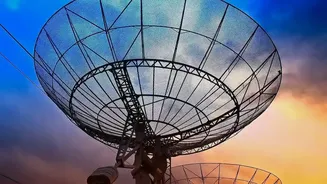
An Observatory on a Global Scale
The Square Kilometre Array, or SKA, is not a single telescope but a vast, interconnected network of thousands of antennas spread across two continents. It is an intergovernmental project designed to build and operate the most sensitive radio telescope on Earth.
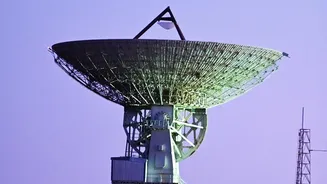
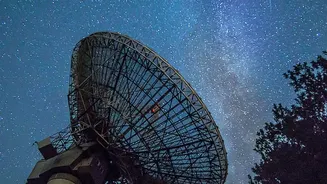
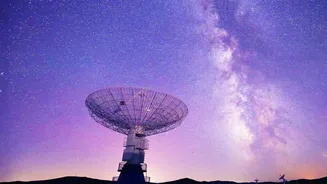
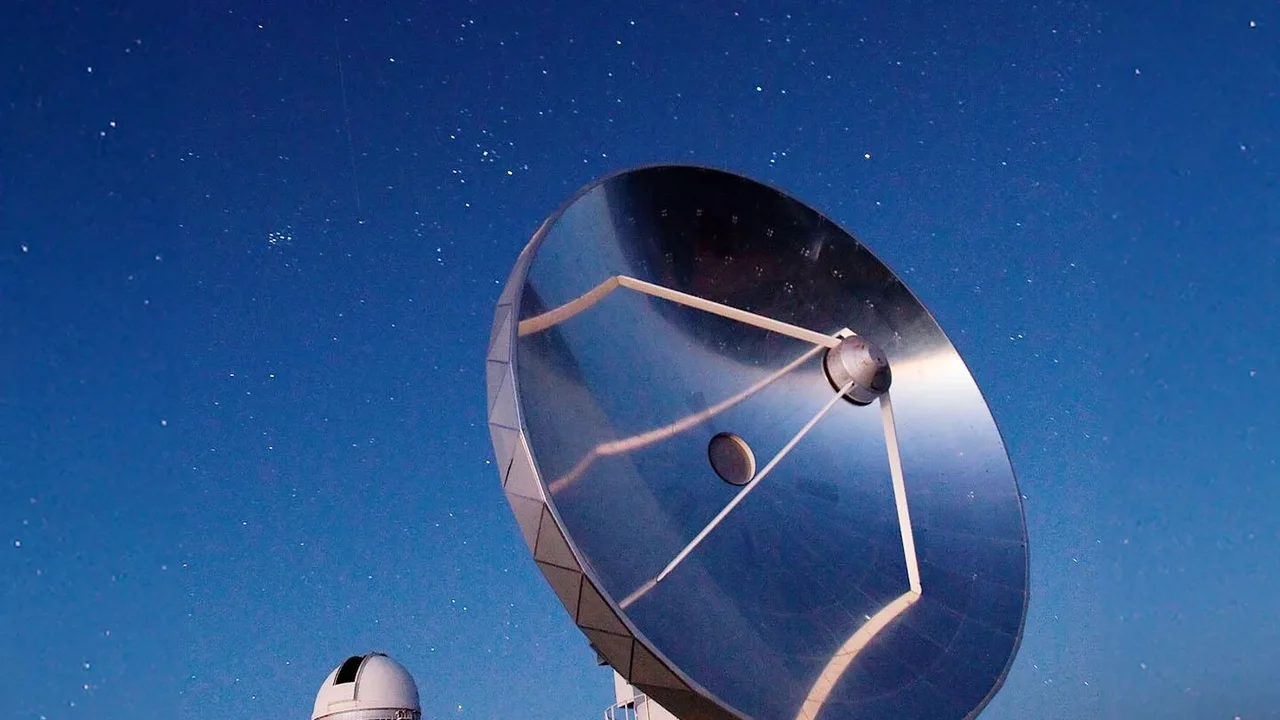
Construction is currently underway in remote, radio-quiet deserts. The SKA-Mid array, featuring 197 dish antennas, is located in South Africa's Karoo region. Simultaneously, the SKA-Low array, composed of over 131,000 Christmas tree-like antennas, is being built in Western Australia. With its headquarters at the Jodrell Bank Observatory in the UK, the SKA Observatory is a collaboration of over a dozen countries, pooling resources and expertise to push the boundaries of science. Construction officially began in late 2022, with first science operations expected toward the end of the decade.
Listening to the Cosmic Dawn
The primary mission driving this colossal project is to observe one of the most mysterious periods in cosmic history: the Cosmic Dawn. This is the era, a few hundred million years after the Big Bang, when the very first stars and galaxies began to ignite, ending the cosmic 'dark ages'. These first light sources were incredibly faint, and their signals have been travelling for over 13 billion years. As the universe expanded, this ancient light has been stretched into long-wavelength radio waves. The SKA is specifically designed to detect these incredibly weak signals, primarily by tracing the signature of neutral hydrogen gas that filled the early universe. By mapping this hydrogen, astronomers can create a 3D picture of how the universe lit up, watching the first cosmic structures emerge.
India's Crucial Role in the Cosmic Quest
India has been a key player in the SKA project from its early days, contributing significantly to its design and development. In a major commitment, the Indian government approved ₹1,250 crore for the project, cementing its position as a full member of the international consortium. The National Centre for Radio Astrophysics (NCRA) in Pune coordinates India's involvement, which spans more than 20 institutions. Indian scientists and engineers have led the design of the Telescope Manager system, the complex 'brain' that will control the entire observatory. India is also making major contributions to digital hardware, software development, and is planning to host an SKA Regional Centre to process the immense volumes of data the telescopes will generate.
Beyond the First Stars
While observing the Cosmic Dawn is a headline goal, the SKA's capabilities will revolutionize many other areas of astronomy. Scientists will use it to conduct the most precise tests of Einstein's theories of gravity by monitoring pulsars, the rapidly spinning cores of dead stars that act as cosmic clocks. The telescope will also help map the structure and evolution of galaxies, investigate the nature of dark matter and dark energy, and chart the role of cosmic magnetism. The SKA's unparalleled sensitivity also opens a new chapter in the search for life beyond Earth, allowing scientists to listen for potential technosignatures—signals that could indicate the presence of advanced alien civilizations—with far greater precision than ever before.