



What Exactly Is This 'Cosmic Kiss'?
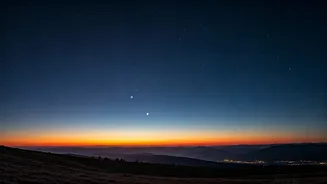
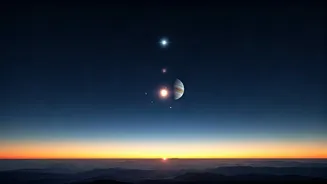
In astronomical terms, what we’re seeing is a conjunction. It’s not a literal “kiss” or collision—far from it! The Moon and Venus remain hundreds of millions of kilometres apart. A conjunction is an celestial event in which two or more astronomical bodies
appear to be very close together in the sky, as viewed from our perspective here on Earth. Think of it as a beautiful optical illusion created by the alignment of our planet, the Moon, and Venus in their respective orbits around the Sun. These alignments are common and create some of the most stunning sights for amateur stargazers because they are bright, easy to spot, and require no special equipment.
The Stars of the Show: Moon and Venus
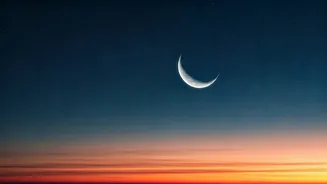
The two objects involved are our closest cosmic neighbours. The Moon, appearing as a delicate, sliver-thin crescent in these events, is our planet’s natural satellite. Its dark portion is sometimes faintly visible due to a phenomenon called 'earthshine'—sunlight reflecting off the Earth to gently illuminate the Moon’s night side.
The other star of the show isn't a star at all. Venus is a planet, often nicknamed the 'Evening Star' or 'Morning Star' because it’s most visible around sunrise or sunset. Its incredible brightness is due to two factors: it is relatively close to Earth, and its atmosphere is covered in thick, highly reflective clouds that bounce a huge amount of sunlight back into space. This makes Venus the brightest natural object in the night sky after the Moon.
How to Watch the Celestial Dance
The best part about a Moon-Venus conjunction is its accessibility. You don’t need a fancy telescope or expensive gear. The key is timing and direction. Start looking about 30 to 45 minutes after sunset. Find a spot with a clear, unobstructed view of the western horizon—the direction where the sun just set. As the twilight deepens, Venus will pop into view as an unmistakably bright, unblinking point of light. On the night of a close conjunction, the crescent Moon will be right there with it, creating a truly memorable pairing. The sight is typically visible for about an hour or two before the celestial pair sinks below the horizon.
Tips for the Perfect Viewing Experience
To make the most of this celestial event, a little preparation goes a long way. First, try to get away from the glare of city lights. Light pollution can wash out the details and the magic of the twilight sky. Even moving to a local park or a rooftop can make a significant difference. Second, give your eyes time to adapt to the dark; it takes about 15-20 minutes for them to become fully sensitive to low light. While not necessary, a simple pair of binoculars can enhance the view dramatically. Through binoculars, you’ll see the crescent Moon in more detail, perhaps even some of its craters along the terminator (the line between light and dark). You might also resolve Venus into a tiny, non-pointy shape.
More Than Just A Pretty Sight
For millennia, humans have looked up at these celestial meetings with a sense of wonder. Venus, named for the Roman goddess of love and beauty, has been a cultural touchstone across civilizations. In Hindu astrology, it is associated with Shukra, the guru of the demons. The Moon, of course, holds deep cultural and religious significance worldwide, governing tides and calendars. When these two powerful symbols meet in the sky, it’s more than just an astronomical event; it’s a connection to the long history of humanity’s relationship with the cosmos. It’s a reminder that we are all, in our own way, stargazers.