






What Are Skyrmions, Anyway?
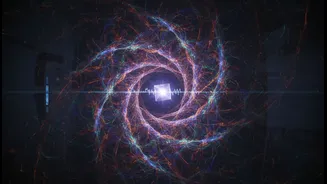
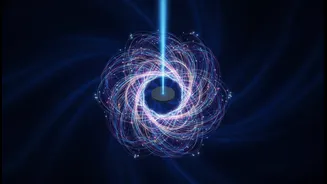
First imagined in the 1960s for particle physics, skyrmions are robust, particle-like knots in a field. Think of them as incredibly stable, tiny whirlpools. For years, the main focus was on magnetic skyrmions, which are swirling patterns of atomic spins
in materials, seen as a promising candidate for ultra-dense and efficient data storage. More recently, scientists realized they could create an equivalent using light itself. These 'optical skyrmions' are intricate, swirling patterns in the polarization and phase of light. Their stability and unique structure mean they could be used to encode, store, and transmit information, making them building blocks for future photonic devices.
A 200-Year-Old Trick of the Light
The second ingredient in this breakthrough is a phenomenon with a fantastic backstory: the Poisson spot, also known as the Arago spot. In 1818, the French Academy of Sciences held a competition to explain light. Engineer Augustin-Jean Fresnel submitted a theory describing light as a wave. The mathematician Siméon Poisson, a member of the judging committee and a believer in the particle theory of light, was deeply skeptical. He argued that if Fresnel was right, then shining light on a perfectly round object should create an impossibly absurd bright spot in the very center of its shadow. Poisson saw this as a fatal flaw that disproved the wave theory. However, another committee member, François Arago, decided to perform the experiment. To Poisson's shock, Arago found the bright spot exactly as predicted. The spot, initially used as a tool for ridicule, became irrefutable proof of the wave nature of light.
Bringing Old and New Physics Together
Recently, a team of scientists at Nanyang Technological University in Singapore decided to revisit this classic experiment with modern tools. They found that instead of using complex, expensive engineered materials called metamaterials, which was the previous method, they could create optical skyrmions much more simply. By shining a laser beam onto a small circular disc, they generated a Poisson spot. But by carefully analyzing the properties of the light within that very spot, they discovered it wasn't just a simple point of light; it contained the complex, swirling topological patterns of optical skyrmions. In fact, their method simultaneously created four different types of skyrmions (related to the electric field, magnetic field, spin, and polarization) all within the same system, giving researchers an unprecedented window into how these structures interact.
Why This Breakthrough Matters for Technology
The significance of this discovery is twofold. First, it dramatically lowers the barrier to entry for studying these exotic light structures. What once required costly and complex fabrication of metamaterials can now be achieved with a simple laser and a disc. This accessibility could accelerate research worldwide, unlocking new insights into the fundamental properties of light. Second, it brings the potential applications of optical skyrmions closer to reality. Because these light patterns are so stable and small, they could be used to create next-generation technologies for high-density data storage, high-speed optical communication, and low-power computing. Their unique properties could also be harnessed for advances in high-resolution imaging and precision metrology, allowing us to measure things on a nanoscale with incredible accuracy.
The Road Ahead: From Lab to Application
While generating skyrmions has now become simpler, the path to commercial technology still has challenges. Researchers will need to refine methods to control, manipulate, and read these optical patterns on demand with high speed and efficiency. The stability of these structures under various conditions also needs further investigation. However, this simplified generation method is a major leap forward. It provides a robust platform for experimentation, allowing scientists to explore the fundamental physics of skyrmions and test their potential in various applications. By providing a 'four-in-one' system, the Poisson spot method allows for direct comparison of different skyrmion types, which could help uncover new physical principles and guide the design of future photonic devices.