




Saturn’s Famous Hexagon
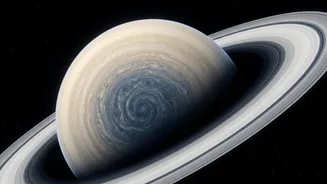
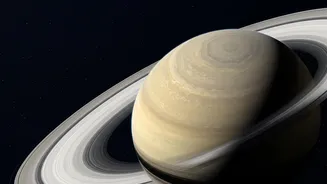
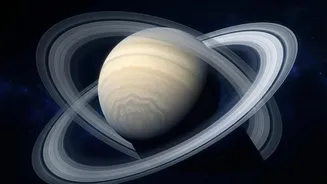
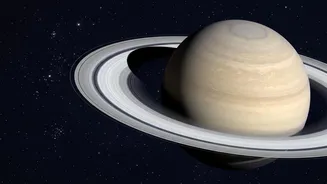
Since it was first spotted by the Voyager probes in the early 1980s, Saturn's northern hexagon has been one of the solar system's most captivating mysteries. It is a massive, six-sided jet stream that encircles the planet's north pole, with each of its
sides being wider than the diameter of Earth itself. For over 40 years, this colossal weather pattern has remained remarkably stable, a permanent fixture in an otherwise chaotic atmosphere. The Cassini spacecraft, which orbited Saturn from 2004 to 2017, provided stunning, up-close views of the phenomenon, showing it changing colour from blue to gold with the passing seasons. Scientists theorised it was a standing wave in the atmosphere, but with nothing else like it in the solar system, it remained a spectacular anomaly.
The Hexagon Gets a Sibling
It turns out the hexagon is no longer alone. Recent observations from the Hubble Space Telescope have revealed a second, entirely new polygon swirling around Saturn's south pole. This new feature is a decagon, a ten-sided atmospheric wave that has appeared in a region where nothing similar had been seen before. The discovery, confirmed in September 2026, was a surprise to astronomers who have been searching for a southern counterpart to the hexagon for decades. NASA's Cassini mission saw no trace of a long-lived polygon before its mission ended in 2017. Thanks to the planet's changing seasons, its south pole only tilted back into Earth’s view in 2023, with hints of the shape first appearing in images taken by amateur astronomers in 2024 before Hubble confirmed it. This suggests the decagon is a brand-new feature, forming sometime in the observational gap after 2017.
The Science of Cosmic Geometry
So how does a planet made of gas create perfect-looking geometric shapes? The answer lies in complex fluid dynamics. These polygons are not solid structures but are patterns within powerful jet streams. Scientists believe they form as a result of atmospheric waves, known as Rossby waves, which occur naturally on rotating planets. When different layers of atmospheric fluid move at different speeds, the interaction between them can create turbulence that settles into stable, polygonal shapes. This effect has even been reproduced in laboratory experiments using rotating tanks of liquid. The new decagon, like the hexagon, is not just a surface feature; it appears to be a deep, vertically stacked structure that extends through multiple cloud layers, indicating it's a major part of the planet's atmospheric engine.
Why These Polygons Matter
The discovery of the decagon is significant because it proves that Saturn's hexagon is not just a fluke. Instead, it suggests the conditions in Saturn's atmosphere are fundamentally capable of generating these strange geometric storms at both of its poles. It provides astronomers with an unprecedented opportunity to watch a massive planetary weather system develop in near real-time, something they missed with the long-established hexagon. While similar, the two polygons are not identical. The decagon has ten sides to the hexagon's six and appears less stable. Studying how the decagon evolves, strengthens, or dissipates will provide invaluable data for understanding the deep convection and powerful jet streams that drive the weather on gas giants, both in our solar system and beyond.