






Step 1: Get Ready for the Night
Your skywatching journey begins before you even step outside. First, check the weather forecast for clear skies. Next, find a location away from the glare of city lights. A local park, a quiet suburban street, or a rural backyard can make a world of difference.
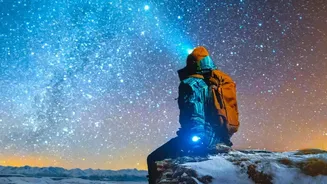
Light pollution washes out fainter stars and celestial wonders, so the darker your spot, the better. Dress in warm layers, as temperatures can drop quickly after sunset, even on a pleasant day. A comfortable chair, a blanket, and a warm drink will make your experience much more enjoyable. Finally, download a stargazing app on your phone, but be prepared to use it sparingly. While apps are great for identifying what you're seeing, the bright screen can ruin your night vision. Many have a 'red light' mode to help preserve it.
Step 2: Let Your Eyes Adjust
This is the most crucial and most often skipped step for any beginner. Once you're in your chosen spot, turn off all lights, put your phone away, and simply sit in the darkness for 15-20 minutes. During this time, your pupils will dilate, and your eyes will become significantly more sensitive to faint light. This process, called dark adaptation, is the key to seeing thousands of stars instead of just a few hundred. Use a red-light flashlight if you need to see your surroundings, as red light has the least impact on your night vision. Patience here will reward you with a far richer view of the cosmos, revealing faint meteors, distant star clusters, and the subtle glow of the Milky Way.
Step 3: Find Your Celestial Bearings
Before you hunt for specific objects, get a feel for the sky. A great starting point for anyone in the Northern Hemisphere is to find Polaris, the North Star. It's not the brightest star in the sky, but it's famous for staying in a fixed position while the other stars appear to revolve around it. The easiest way to find it is by using the Big Dipper, which in October is low in the northwestern sky. Find the two stars that form the outer edge of the Dipper's 'bowl' and trace a straight line up from them. This line will point you directly to Polaris. Once you've found north, you can orient yourself to any star chart or app. High overhead in the evening, look for the 'Summer Triangle', an asterism formed by the three bright stars Vega, Deneb, and Altair, which is still prominent.
Step 4: The Main Events of October 2026
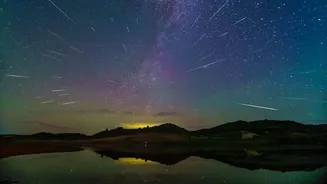
October is a fantastic month for planet-watching. The star of the show is Saturn, which reaches opposition on October 4. This means it will be at its closest to Earth, visible all night as a bright, steady light. Look for it rising in the east around sunset. While its famous rings require a telescope, its bright presence is unmissable to the naked eye. In the pre-dawn hours, look east to find bright Jupiter and reddish Mars rising. On the morning of October 5, the crescent Moon will create a beautiful pairing with Mars. October also hosts two meteor showers. First are the Draconids, peaking on the evening of October 8-9. Uniquely, this shower is best viewed right after nightfall, not after midnight. With the New Moon on October 10, the sky will be perfectly dark for spotting these meteors, though it's typically a modest shower with about 5-10 meteors per hour. Later in the month, the Orionids peak on the night of October 21-22. These are fast, bright meteors created by debris from Halley's Comet. The Moon will be bright in the evening but will set a few hours before dawn, opening a dark window for a great show.
Step 5: Go Beyond the Naked Eye
Once you're comfortable, even a simple pair of binoculars can unlock a new layer of the universe. Scan the area where the Milky Way stretches across the sky to resolve the hazy band into countless individual stars. Look toward the constellation Cassiopeia, a prominent 'W' shape in the northern sky. Then, find Taurus, identifiable by a V-shape of stars called the Hyades cluster which forms the bull's face. Nearby is a stunning object for binoculars: the Pleiades star cluster, also known as the Seven Sisters. To the naked eye, it looks like a tiny, misty patch, but binoculars will reveal a breathtaking cluster of brilliant blue stars. Binoculars are also great for getting a better look at Jupiter's four largest moons, which appear as tiny dots of light flanking the planet.