








The Disappearing Training Ground
Entry-level jobs have always been more than just a first paycheque. They were the professional world's training ground. Roles built on routine tasks—like data entry, generating standard reports, or handling basic customer queries—gave new graduates a foothold
in the corporate world. This 'grunt work' was where you learned the unwritten rules of an office, built a professional network, and developed the basic skills and institutional knowledge needed for advancement. It was a system of informal apprenticeship; by mastering the simple, you earned the right to tackle the complex. Companies invested in this layer, knowing it was the pipeline for their future managers and leaders. But this entire layer is now being compressed by technology.
When AI Does the Junior Work
Artificial intelligence and automation are proving exceptionally good at the predictable, rules-based tasks that once defined junior roles. In India, this is not a future trend; it's a present reality. Across the IT, BPO, and banking sectors, AI is already handling a significant portion of entry-level work. For instance, major Indian banks use AI chatbots to manage 60-70% of initial customer queries. A 2023 NASSCOM study found that two-thirds of Indian BPO firms had automated over half of their data processing work. The result isn't necessarily mass layoffs, but a structural shift. Companies now need fewer people for the same output, leading to a marked slowdown in fresher hiring in sectors that once absorbed millions of young Indians into the workforce. The job isn't always vanishing, but the tasks within it are changing profoundly.
The Problem of the Broken Ladder
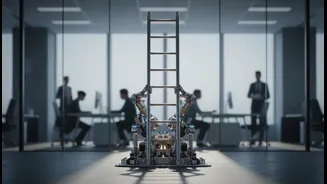
When the first rung of the ladder disappears, it creates a twofold crisis. For aspiring professionals, the barrier to entry gets higher. With routine tasks automated, employers now expect new hires to arrive with stronger analytical, problem-solving, and collaborative skills from day one. Some data shows job postings for entry-level roles increasingly require several years of experience, creating a paradoxical trap for graduates. For companies, the long-term risk is a weakened talent pipeline. If fewer people get the chance to build foundational experience, where will the next generation of specialists, managers, and leaders come from? This erosion of early career paths can lead to a 'missing middle' in the workforce, making it harder to promote from within and creating a future leadership vacuum.
Building New Pathways to Growth
The traditional ladder may be broken, but new models for career progression are emerging. The focus is shifting from performing repetitive tasks to leveraging technology for higher-value work. The new 'entry-level' job is less about execution and more about oversight, problem-solving, and collaborating with AI systems. This means the skills in demand have changed. Technical literacy is a given, but uniquely human skills—critical thinking, creativity, emotional intelligence, and communication—are becoming more valuable because they are difficult to automate. To adapt, companies are rethinking how they onboard talent, focusing on project-based learning and creating new roles like 'AI trainer' or 'automation orchestrator'. For individuals, the key is no longer to master a specific tool, but to understand workflows and cultivate a mindset of continuous learning.