






It's All About the Vibe
Think of the last concert you went to. You didn't just hear the music; you *felt* the bass drum thumping in your chest. That's sound in action. On Earth, sound is a mechanical wave, which is a fancy way of saying it’s a vibration that needs to travel
through something—a medium. When a guitar string is plucked, it vibrates. Those vibrations push on nearby air molecules, which push on the molecules next to them, creating a chain reaction that eventually reaches your eardrum. Your brain then interprets these vibrations as sound. It’s like dropping a pebble in a pond; the ripples spread out, but they need the water to exist. Sound works the same way through air, water, or even solid objects like a wall. No medium, no vibration transfer, no sound.
The Emptiness of Everything
The primary reason space is silent is that it's an almost-perfect vacuum. While it’s not *completely* empty—there are stray gas particles, dust, and plasma floating around—the molecules are incredibly far apart. On Earth, at sea level, there are about 25 quintillion molecules in a single cubic centimeter of air. In interstellar space, that number drops to just a handful of atoms. This vast distance between particles means there's nothing for a sound wave to "push" against. A vibrating object, like an exploding star, has no neighboring molecules to bump into to start that chain reaction. The vibrations have nowhere to go. So, a supernova might be one of the most powerful events in the universe, but it happens in absolute, deafening silence.
How Astronauts Break the Silence
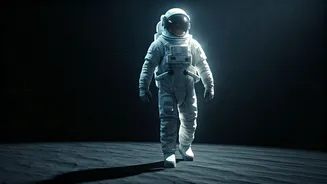
If space is silent, how do astronauts on a spacewalk talk to each other or to Mission Control? They cheat, using technology. Their helmets are equipped with radios that convert the sound waves of their voices into radio waves. Unlike sound waves, radio waves are a form of electromagnetic radiation, like light. They don't need a medium to travel and can move through the vacuum of space at the speed of light. A transmitter in one astronaut's helmet sends the radio wave, and a receiver in another's helmet picks it up and converts it back into sound inside their pressurized, air-filled suit. It's the same principle your car radio uses, just on a much more critical scale. Inside a spacecraft like the International Space Station, it's a different story. The station is filled with a breathable atmosphere, so sound travels just fine.
But Didn't NASA Record a Sound?
You may have seen recent headlines about NASA capturing the "sound" of a black hole. This is both true and a little misleading. Astronomers didn't point a microphone at a black hole. What they did was observe the Perseus galaxy cluster, which is filled with a massive cloud of hot gas. The black hole at the cluster's center sends out pressure waves—ripples—through this gas. While these are technically sound waves, they are at a frequency billions of times lower than what humans can hear. Scientists used data from the Chandra X-ray Observatory to track these ripples, then scaled up their frequency into the human hearing range. This process, called data sonification, translates astronomical data into sound. So we aren't hearing sound that traveled through a vacuum; we're hearing a representation of physical events happening within a medium (a gas cloud) far, far away.
Hollywood's Explosive Lies
From the thundering engines of the Millennium Falcon to the deafening explosions of the Death Star, Hollywood has taught us that space is a noisy place. The reason is simple: it’s more dramatic. Silent space battles would feel sterile and anticlimactic to audiences accustomed to visceral sound design. Sound is a powerful tool for storytelling, conveying power, danger, and excitement. A few films, however, have famously embraced the silence. Stanley Kubrick’s *2001: A Space Odyssey* features long, silent scenes in space that create a sense of awe and isolation. More recently, *Gravity* used sound brilliantly, often cutting to silence during exterior shots to immerse the viewer in the terrifying reality of being stranded in a vacuum. These films prove that silence, used correctly, can be even more powerful than a loud explosion.