



Seeing the Invisible Universe
The magic of the James Webb Space Telescope (JWST) lies in its powerful infrared eyes. Unlike the Hubble Space Telescope, which primarily observes visible and ultraviolet light, Webb is designed to see the universe in infrared. This is crucial because
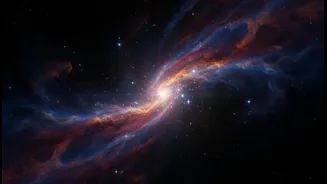
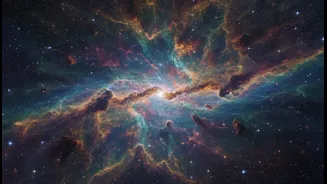
the most distant, and therefore earliest, galaxies have had their light stretched into longer, redder wavelengths by the expansion of the universe. Infrared light also allows astronomers to peer through the dense clouds of cosmic dust that obscure the birth of stars and planetary systems. What was once a shrouded mystery to other telescopes is an open book to Webb, giving us an unprecedented view of stellar nurseries and the building blocks of galaxies. This capability is not just an upgrade; it's a completely new way of seeing, enabling us to witness cosmic events that were previously hidden from view.
From Deep Space to Your Screen
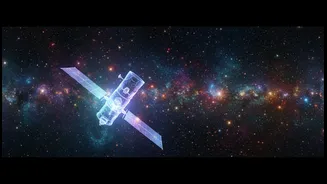
The phrase “in the feed” is more literal than you might think. From its stable orbit 1.5 million kilometers from Earth, Webb constantly gathers data. Twice a day, it sends a high-speed data package of up to 28.6 gigabytes back to the Deep Space Network. From there, the raw data travels to the Space Telescope Science Institute (STScI) in Baltimore, USA. At STScI, the data undergoes a multi-stage calibration process. Raw signals are cleaned of instrumental artifacts, corrected for detector eccentricities, and translated from black-and-white sensor data into the stunning, color-coded images that capture the public's imagination. This calibrated data is then made publicly available through the Mikulski Archive for Space Telescopes (MAST), creating a continuous, accessible feed for scientists—and the public—worldwide.
A Torrent of Discovery
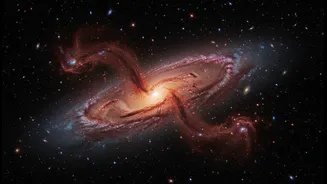
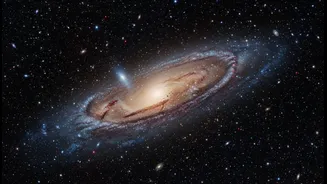
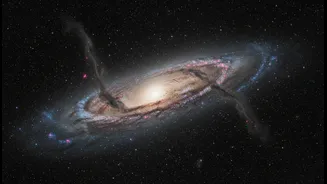
The constant flow of high-quality data is accelerating the pace of discovery. In the four years since its first images were released, Webb has transformed astronomy. To celebrate its fourth anniversary in July 2026, NASA released breathtaking new images of Centaurus A, a galaxy shaped by a cosmic collision some two billion years ago. Where Hubble’s view was blocked by dust, Webb’s infrared instruments cut through the haze to reveal a tapestry of individual stars, allowing for a kind of 'galactic archaeology' to reconstruct the galaxy's history star by star. Beyond single images, Webb's data is fueling massive survey projects. One recent effort produced the largest-ever 3D map of the universe's structure, known as the cosmic web, charting the evolution of 164,000 galaxies and providing new clues about how star formation is influenced by this grand structure. Webb has also provided the clearest evidence of black holes forming before their host galaxies and identified the earliest supernova ever recorded.
Redefining How Science is Done
The telescope’s impact goes beyond individual discoveries. The sheer volume and accessibility of the data are changing the workflow of astronomy itself. Instead of waiting years for observation time on a powerful instrument, researchers can now tap into the public archive to conduct novel science. The immediate availability of data from Early Release Science programs has enabled the community to quickly understand the telescope's capabilities. This open-data model fosters collaboration and allows for a more dynamic and responsive scientific process. Findings are challenging and refining our fundamental understanding of the cosmos at a bewildering pace. Theories about how the first galaxies formed and grew are being rewritten based on Webb's observations of an early universe populated with surprisingly bright and massive galaxies. This constant stream of information is not just adding to our knowledge; it's actively reshaping the questions we ask about the universe.