


A Glimpse into Alien Skies
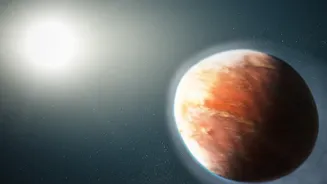
In a landmark observation, astronomers have used the James Webb Space Telescope (JWST) to analyse the atmosphere of a far-off exoplanet, confirming the presence of water vapour. Recent studies have highlighted planets like TOI-421 b, a 'sub-Neptune' world
about 244 light-years away, and WASP-107b, a 'fluffy' gas giant. While finding water in space isn't new, the level of detail provided by JWST is a genuine breakthrough. For the first time, we are not just detecting a faint signal; we are beginning to paint a detailed chemical portrait of the air on other worlds. This capability allows scientists to move beyond simply asking 'is there water?' to asking 'how much is there, and what else is in the atmosphere?'. The precision of these new instruments is what separates previous findings from this new era of exploration.
The Telescope That Makes It Possible
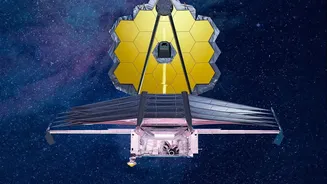
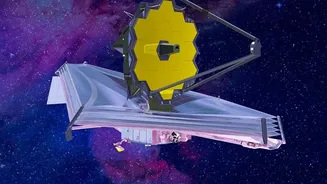
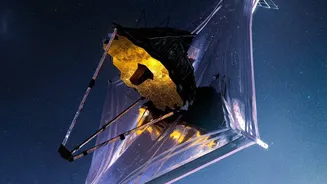
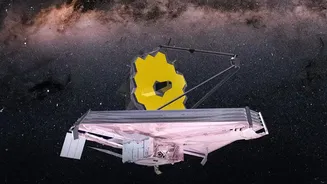
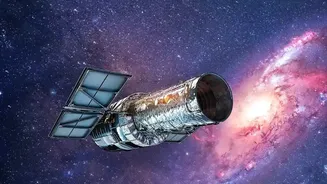
The James Webb Space Telescope is uniquely equipped for this kind of work. Unlike its predecessor, the Hubble Space Telescope, JWST is designed to see the universe in infrared light. This is crucial for analysing exoplanet atmospheres. When an exoplanet passes in front of its host star from our perspective, a tiny fraction of the starlight filters through the planet's atmosphere. Different gas molecules absorb specific wavelengths of light, leaving a unique chemical fingerprint in the light that reaches the telescope. JWST's highly sensitive spectrographs, like the Near-Infrared Spectrograph (NIRSpec), can decipher these fingerprints with unprecedented accuracy. This technology allows scientists to identify not just water, but other key molecules like methane, carbon dioxide, and sulfur dioxide, giving us a more complete inventory of an alien sky.
Why Water Vapour Is So Important
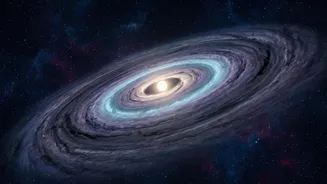
On Earth, life as we know it is inextricably linked to water. It is the universal solvent, facilitating the chemical reactions that make biology possible. Finding water vapour in the atmosphere of an exoplanet is a critical first step in assessing its potential for hosting life. While the presence of water vapour alone does not mean a planet is habitable—many of these initial discoveries are on scorching hot gas giants where life as we know it could not survive—it is a foundational piece of the puzzle. Scientists are particularly interested in finding water in the 'habitable zone' around a star, the region where temperatures could allow liquid water to exist on a planet's surface. JWST has already detected water in a planet-forming disk in this very zone, suggesting that rocky planets may have access to water from their inception.
Building a Picture of Other Worlds
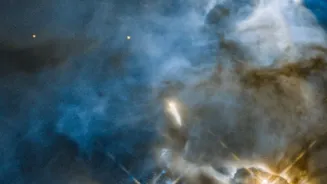
The true breakthrough of JWST is its ability to see the bigger picture. In the atmosphere of WASP-107b, for example, scientists found not only water vapour but also sulfur dioxide and even clouds made of silicate sand. This kind of detailed composition helps them understand the planet's climate and geology. On other planets, like TOI-270 d, the data suggests a potential 'water world' with a deep global ocean under a steamy atmosphere, though interpretations can vary. These combinations of different molecules tell a story about how the planet formed and evolved. The absence of certain chemicals can be just as telling as their presence. This holistic view is transforming exoplanet science from a process of discovery to one of true characterisation.
A New Era in the Search for Life
These findings are more than just isolated discoveries; they are a powerful demonstration of what is now possible. Every observation serves as a crucial test of JWST's capabilities and refines the techniques astronomers will use to hunt for smaller, Earth-like worlds. The ultimate goal is to find a rocky planet in a habitable zone and scan its atmosphere for a combination of gases—like oxygen, methane, and water vapour—that could indicate the presence of biological processes. While a definitive detection of an atmosphere on a rocky exoplanet remains a challenging frontier, recent evidence for one on a super-Earth called TOI-561 b shows we are getting closer. The James Webb Space Telescope has officially opened a new chapter, turning the abstract search for habitable worlds into a tangible scientific pursuit.