



SpaceX plans to catch its massive Super Heavy rocket booster using giant arms on the launch tower. It sounds like science fiction, but this audacious method is the key to the company’s entire strategy for rapid and affordable spaceflight.
Meet 'Mechazilla': More Than Just a Launch Tower
At the heart
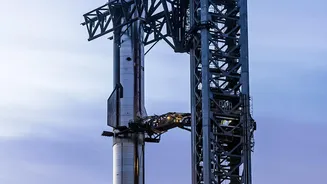
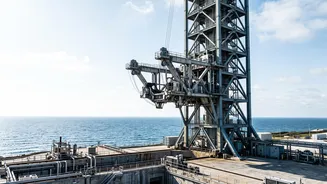
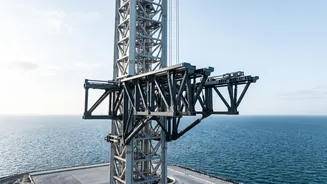
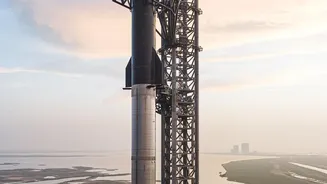
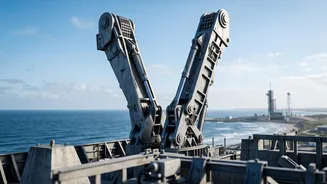
of SpaceX's strategy is the launch and integration tower, nicknamed 'Mechazilla' by the space community. Standing over 400 feet tall, this isn't just a static structure for holding the rocket before launch; it's an active and essential part of the recovery process. Its most prominent features are two massive mechanical arms, often called the 'chopsticks'. These arms perform the dual role of stacking the Starship spacecraft atop the Super Heavy booster before a flight and, in a far more dramatic fashion, catching the booster as it returns from the edge of space. This system is designed to treat the rocket and the ground infrastructure as one integrated machine, fundamentally changing the architecture of launch and recovery.
The Catch Sequence: A High-Stakes Ballet
The process of catching the Super Heavy booster is a marvel of engineering and precision. After separating from the Starship upper stage, the 71-meter-tall booster performs a series of engine burns to reverse its course and fly back to the launch site. Using four large, waffle-patterned grid fins for aerodynamic steering, it guides itself through the atmosphere. As it approaches the tower, the booster fires its Raptor engines for a final landing burn, slowing its descent to nearly zero velocity at the precise altitude and position of the waiting 'chopstick' arms. Advanced guidance systems, including high-resolution cameras and LiDAR, track the booster's descent with centimetre-level accuracy, allowing the arms to adjust in real-time. The arms then close around structural hardpoints on the booster, absorbing the remaining energy and securing the massive vehicle.
Why Not Just Use Landing Legs?
SpaceX has extensive experience landing its Falcon 9 boosters using legs, so the switch to a tower catch might seem overly complex. However, the reasons are rooted in efficiency and speed. Firstly, eliminating landing legs saves an immense amount of weight. For a vehicle the size of Super Heavy, landing legs would need to be massive and heavy, and every kilogram saved on the rocket translates directly into more payload capacity for a mission. Secondly, the catch method is designed for ultra-fast reusability. Catching the booster and placing it directly back onto the launch mount eliminates the time-consuming process of transporting it from a separate landing pad, a process that can take days or weeks with the Falcon 9. This makes SpaceX's goal of re-flying a booster within an hour theoretically possible.
The Challenges and the Payoff
This method is not without immense challenges. The maneuver requires near-perfect reliability from the booster's guidance, propulsion, and control systems, as the 'chopsticks' offer a much smaller and less forgiving target than a large landing pad. The system must be fully autonomous, with the flight computer making the final go/no-go decision based on whether the booster's trajectory is within tight tolerances. The payoff for mastering this high-risk maneuver, however, is transformative. Full and rapid reusability could dramatically lower the cost of accessing space, with SpaceX aiming to reduce it by 99% compared to historical averages. This economic shift is what underpins the company's ambitious long-term goals, from deploying its next-generation Starlink satellite network to enabling crewed missions to the Moon and Mars.
From Theory to Reality
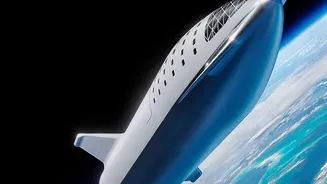
The tower catch is no longer just a concept. SpaceX successfully caught a Super Heavy booster for the first time on October 13, 2024, during the vehicle's fifth test flight. That booster, B12, was caught cleanly by the Mechazilla arms, proving the viability of the system and marking a major milestone in aerospace history. While subsequent flights have continued to test different parameters, with some boosters splashing down in the Gulf of Mexico as planned, the initial success validated the engineering principles. The company is now working toward making the catch a routine part of operations and has even stated its intention to eventually catch the Starship upper stage in the same manner, which would be the final piece of the puzzle for a fully reusable launch system.