



A Steamy, Hazy Revelation
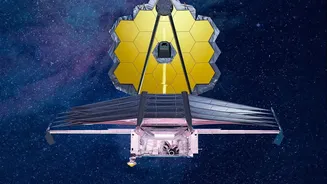
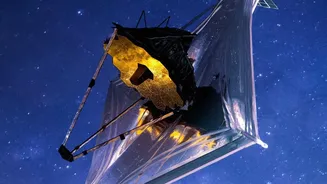
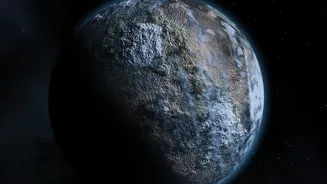
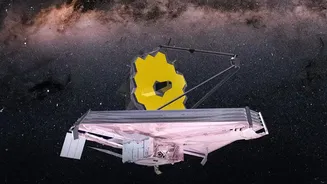
The planet at the center of recent excitement is GJ 1214 b, a world located about 40 light-years away. For years, it remained an enigma, its secrets shrouded by a thick haze that older telescopes like Hubble could not penetrate. But the JWST, with its powerful
infrared vision, has finally peered through the veil. The data revealed compelling evidence of water vapour in its atmosphere. However, this is no temperate paradise. GJ 1214 b orbits its star so closely that it completes a full year in just 38 hours, resulting in scorching daytime temperatures of around 280 degrees Celsius. Under these conditions, any water would exist as super-heated steam, making the world inhospitable to life as we know it. The discovery is less about finding a new Earth and more about proving the technology can find the ingredients for one.
What Are Super-Earths?
Super-Earths are a class of exoplanet more massive than Earth but lighter than our solar system's ice giants, Uranus and Neptune. They are among the most common types of planets discovered in the Milky Way, yet our own solar system curiously lacks one. This makes them a fascinating and crucial area of study. Their larger mass gives them a stronger gravitational pull, which helps them retain their atmospheres over billions of years—a key factor for long-term climate stability. Scientists believe these worlds come in a wide variety, from dense, rocky planets to those completely covered by deep, global oceans, which are often called 'water worlds'. Studying them helps us understand the vast possibilities of planetary formation across the galaxy.
Reading Light From Light-Years Away
Detecting what a planet's atmosphere is made of from trillions of kilometers away is a monumental feat of engineering and science. The primary method is called transmission spectroscopy. When an exoplanet passes in front of its host star from our perspective, a tiny amount of starlight filters through the planet's atmosphere. Different gases and molecules absorb specific wavelengths, or colors, of this light. By analyzing the starlight that reaches the JWST, scientists can see which wavelengths are missing and deduce the chemical composition of the atmosphere. For GJ 1214 b, astronomers used an even more advanced technique, creating a heat map by measuring the infrared light the planet itself emits as it orbits its star. This provided a more complete picture of its atmospheric makeup.
Why Water Vapour Is a Game-Changer
Water is the cornerstone of life on Earth, so finding it elsewhere, even as vapour, is a profound step in the search for extraterrestrial life. While the detection of steam on a scorching-hot planet like GJ 1214 b doesn't imply habitability, it serves as a critical proof of concept. It demonstrates that the JWST can successfully identify water signatures in the atmospheres of rocky or semi-rocky exoplanets. This capability allows astronomers to build a catalogue of worlds with water, which they can then cross-reference with other factors like temperature and size to prioritize targets for further investigation. It narrows the search from countless star systems to a more manageable list of promising candidates that might just have the right conditions for liquid water on their surface.
The Road Ahead in Our Cosmic Search
This discovery is not an endpoint but the beginning of a new chapter in exoplanet science. The next steps involve using the JWST to study the atmospheres of a wider variety of super-Earths, particularly those orbiting within their star's habitable zone—the region where temperatures could allow for liquid water. Scientists will be looking for more than just water; they'll hunt for a cocktail of biosignature gases like methane, oxygen, and carbon dioxide, which, in the right combination, could point toward biological processes. Each new detection helps refine theories about how planets form and evolve. While finding a true Earth twin remains a long-term goal, the ability to dissect the skies of distant worlds is transforming an age-old question from philosophy into an observational science.