






The Underrated Power of the Step-Up
The step-up is a fundamental human movement we perform daily when climbing stairs or stepping onto a curb. As an exercise, it’s brilliant in its simplicity and effectiveness. Each repetition is a single-leg effort, making it excellent for building functional
strength in your quadriceps, glutes, and hamstrings. It also challenges and improves your balance and stability by forcing the smaller stabilising muscles in your hips, knees, and ankles to work together. Because each leg works independently, step-ups quickly reveal strength imbalances between your left and right sides, giving you a chance to correct them before they cause issues.
Playground Prep and Safety First
Before you begin, survey the playground for a suitable platform. Look for a sturdy, stable, and flat surface. Good options for beginners include the bottom step of a slide structure, a low, wide bench, or even a reinforced retaining wall. A good starting height is between 15 and 20 cm. As a general rule, your knee should not bend more than 90 degrees when your foot is on the platform. If you have to excessively lean forward or feel unstable, the step is too high. Always test the surface to ensure it doesn't wobble. A quick warm-up of light walking, leg swings, and bodyweight squats will prepare your muscles for the work ahead.
Mastering the Basic Step-Up Form
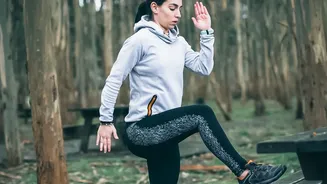
Proper form is crucial to get the benefits and avoid injury. Stand facing your chosen platform. Place your entire right foot firmly on the surface, making sure your heel is fully supported, not hanging off the edge. Lean your torso slightly forward, shifting your weight onto your right leg. The most important part is to drive through the heel and midfoot of your right leg to lift your body up. Avoid pushing off forcefully with your back (left) foot; it should be more of a passenger. Stand up straight at the top, bringing your left foot to meet your right. To descend, step back down with your left foot first, controlling the movement with your right leg. Perform all repetitions on one side before switching.
Variation 1: The Low-Step Start
If you are new to exercise or have concerns about balance, the best thing you can do is start low. Using a platform that is only a few inches high allows you to master the movement pattern without feeling intimidated. The bottom step of a playground set is often perfect for this. You can even hold onto a railing for extra support as you learn the motion. The goal here is not intensity, but control. Focus on a smooth, steady upward push and an equally controlled lowering. Once you can perform 10-12 repetitions on each leg with perfect form and no hand support, you are ready to try a slightly higher surface.
Variation 2: Eccentric-Focused Tap-Downs
This variation emphasizes the lowering phase of the exercise, which is fantastic for building strength and control. Step up onto your platform as you normally would. At the top, balance on your working leg. Instead of bringing your other foot down immediately, lower it slowly and deliberately over a count of three seconds until your toe just taps the ground. Then, drive back up to the starting position on the box without resting your foot on the ground. This slow, controlled descent, known as the eccentric phase, builds strength that is crucial for joint health and injury prevention.
Variation 3: The Lateral Step-Up
The lateral, or side, step-up challenges your muscles in a different plane of motion, which is great for overall hip stability. Stand with your right side next to the platform. Place your right foot on top of it. Keeping your torso upright, push through your right foot to lift your body sideways onto the platform, standing tall. Your left leg comes along for the ride. This variation places more emphasis on the gluteus medius (the muscle on the side of your hip), which is vital for preventing your knee from collapsing inward during movements like running and squatting. Lower yourself back down with control to the starting position and repeat before switching sides.
Common Mistakes to Avoid
To get the most out of your workout and stay safe, watch out for these common errors. The biggest mistake is pushing off forcefully with the back foot, which takes the work away from the lead leg. Another is choosing a step that is too high, forcing you to lean too far forward and strain your lower back. Make sure your entire foot is on the platform; a dangling heel creates instability. Finally, avoid letting your knee cave inward as you push up. Focus on keeping your knee aligned over the middle of your foot throughout the entire movement.