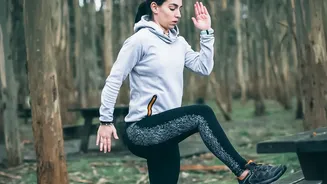



When the weather turns cold, indoor workouts become essential. The humble step-up is a powerhouse for building lower-body strength, but its effectiveness hinges on one key detail: a stable and consistent step height. Here’s why it matters.
The Unilateral Advantage
Step-ups are
a form of unilateral training, meaning you work one leg at a time. This approach offers unique benefits that bilateral exercises like standard squats can't. By isolating each leg, you force the smaller stabilizing muscles in your hips, knees, and ankles to engage, improving your overall balance and coordination. This is crucial not just for athletic performance but for everyday movements like climbing stairs or navigating uneven surfaces. More importantly, unilateral work exposes and corrects strength imbalances between your left and right sides. Often, a stronger leg will compensate for a weaker one in two-legged exercises, but step-ups ensure both sides develop evenly, which can reduce the risk of injury.
Why 'Stable Height' Is Key
The phrase 'stable step height' refers to two things: using a platform that doesn’t wobble and, just as importantly, using the same height consistently throughout your workout. A fixed, unchanging height provides a reliable benchmark for progress. It ensures that the range of motion and muscular demand are identical for every repetition. This consistency is the foundation of progressive overload—the principle of gradually increasing the demand on your muscles. If you use a slightly different height each time, you can't accurately measure whether you're getting stronger. A stable height ensures that when you add weight or reps, the difficulty increase is intentional and measurable, not just a random product of a taller step.
Finding Your Ideal Step Height
Choosing the right height is critical for both safety and effectiveness. A common guideline is to select a platform height where, when you place your foot flat on top, your knee forms an angle of 90 degrees or slightly more. If the step is too high, causing your knee to bend much deeper than 90 degrees, you place excessive stress on the knee joint. It also encourages you to push off with your back foot rather than lifting with the front leg, which defeats the purpose of the exercise. For most people, a height between 12 and 18 inches is appropriate. Beginners should start with a lower step, around 4 to 8 inches, to master the form before attempting a higher platform.
Perfecting Your Step-Up Form
Proper form ensures you target the right muscles—primarily the glutes and quadriceps—and protect your joints. Stand facing the box and place your entire lead foot firmly on the surface, from heel to toe. Keep your torso upright and your core engaged. The most important part of the movement is to drive through the heel of your front foot to lift your body. Avoid pushing off forcefully with your back leg; it should only be used for balance. Stand up fully on the box, bringing your trailing foot to meet the lead foot. Then, control the movement as you step back down, reversing the motion slowly instead of letting gravity take over. Start by performing all reps on one leg before switching to the other.
How to Progress and Add Challenge
Once you have mastered the bodyweight step-up with perfect form, there are several ways to make the exercise more challenging without necessarily increasing the step height. The most straightforward method is to add resistance by holding dumbbells or kettlebells. You can also manipulate the tempo by slowing down the lowering (eccentric) phase of the movement, which increases the time your muscles are under tension. Another variation is the lateral step-up, where you stand beside the box and step up sideways, which places more emphasis on the gluteus medius (the muscles on the side of your hips) and adds a balance challenge.