



Seeing the Unseen Universe
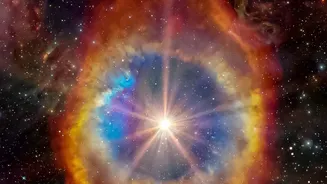
The brilliant colors of a nebula or the sharp glow of a distant star are all forms of visible light, a tiny slice of the vast electromagnetic spectrum. This spectrum includes everything from long-wavelength, low-energy radio waves to short-wavelength,
high-energy gamma rays. Different celestial objects and events emit light at different wavelengths, depending on their temperature and composition. To get a complete picture of a galaxy, astronomers need to look beyond what the human eye can see. By using specialized telescopes, they can observe these invisible wavelengths and uncover a hidden cosmos of activity that would otherwise go unnoticed. This multi-wavelength approach is crucial for understanding the full life cycle of stars, galaxies, and the universe itself.
Radio: Listening to the Cold Cosmos
Radio telescopes are designed to detect the longest, lowest-energy waves in the spectrum. Much like tuning a car radio to a specific station, these giant dishes can be tuned to detect faint radio signals from space. They don't see stars in the way optical telescopes do; instead, they reveal phenomena that are cool and vast. Radio astronomy allows us to map out enormous clouds of cold hydrogen gas, which is the raw fuel for future star formation. It also unveils the dramatic remnants of supernova explosions and detects pulsars, which are rapidly spinning dead stars that emit beams of radio waves like a cosmic lighthouse. Because radio waves can pass through the dense dust clouds that obscure visible light, they provide a clear view of otherwise hidden regions, such as the heart of our own Milky Way galaxy.
Infrared: Peering Through Cosmic Dust
Infrared radiation is essentially heat. Any object with a temperature, even one that is very cold, emits infrared light. Telescopes like the James Webb Space Telescope are revolutionary because they are designed to capture this light. The key advantage of infrared is its ability to penetrate the dense clouds of interstellar gas and dust that block shorter wavelengths like visible light. This gives astronomers a powerful tool to peer into stellar nurseries, revealing newborn stars and protoplanetary disks that are completely hidden from optical view. It also allows for the detection of cooler, fainter objects, such as brown dwarfs (failed stars) and exoplanets, which are too dim to be seen in visible light against the glare of their parent stars. By detecting heat, infrared telescopes unlock a universe of formation and unseen worlds.
X-Ray: Witnessing Galactic Violence
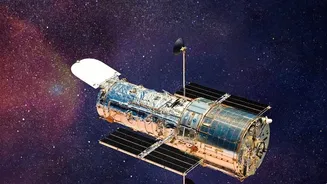
At the other end of the energy spectrum are X-rays. These are highly energetic photons produced by the most extreme and violent processes in the universe. Since Earth's atmosphere blocks X-rays from space, these telescopes must be placed in orbit. Observatories like NASA's Chandra X-ray Observatory are our eyes on this high-energy cosmos. X-ray telescopes reveal matter superheated to millions of degrees. This allows them to see gas spiraling into supermassive black holes at the centers of galaxies, material from one star being ripped away by a dense companion like a neutron star, and the shockwaves from supernova explosions rippling through space. They also observe the vast clouds of hot gas that permeate galaxy clusters, which are the largest structures in the universe. X-ray astronomy shows us a universe that is dynamic, chaotic, and incredibly powerful.
The Complete Picture
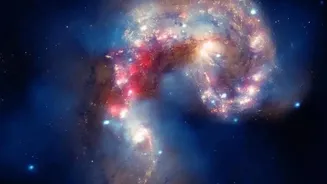
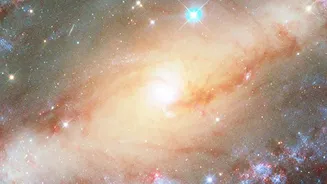
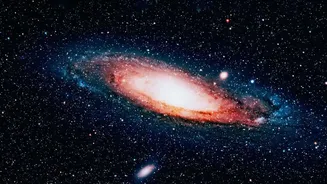
Each type of telescope provides a unique and essential piece of the cosmic puzzle. A galaxy viewed in visible light might show its population of stars, but switch to an infrared view and you'll see the glowing dust lanes where new stars are forming. A radio image might reveal the vast hydrogen clouds fueling that formation, while an X-ray image pinpoints black holes and supernova remnants. Astronomers often combine data from these different telescopes to create stunning composite images. In these false-color pictures, data from each wavelength is assigned a different color—for example, red for radio, green for infrared, and blue for X-ray. The result is not just a beautiful picture, but a rich, multi-layered map that reveals the complex interplay of gas, dust, stars, and high-energy events that shape a galaxy's existence.