






More Than Just Fabric
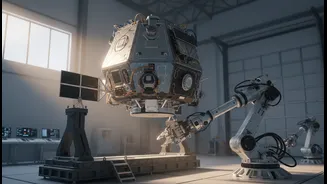
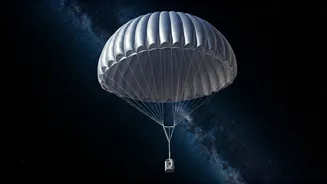
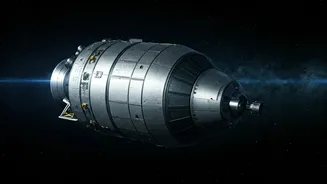
A spacecraft’s parachute system is a world away from a standard skydiver’s rig. For missions like India's Gaganyaan, which will carry astronauts, the system is a complex, multi-stage marvel of engineering designed to handle incredible stress. The Gaganyaan module
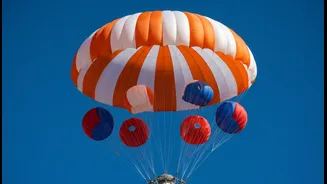
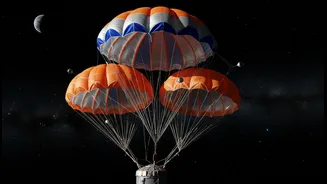
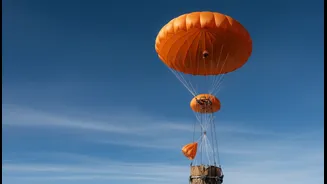
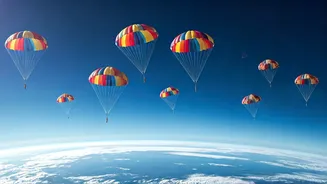
uses a sequence of 10 different parachutes. It all begins after the module has blazed through the most intense phase of re-entry. First, two apex cover separation parachutes fire to jettison the protective shield covering the parachute compartment. Then, two drogue parachutes deploy. These smaller, robust chutes are crucial for initial stabilisation, preventing the capsule from tumbling and reducing its velocity from supersonic speeds. Only after the drogue chutes have done their job do three pilot parachutes emerge, each pulling out one of the three massive main parachutes that slow the capsule to a gentle splashdown speed. Each step must be flawless, as failure at any point could be catastrophic.
India's Proving Grounds
Ensuring this complex sequence works every time requires rigorous testing, and India has developed world-class facilities for this purpose, primarily through the Defence Research and Development Organisation (DRDO). The Aerial Delivery Research and Development Establishment (ADRDE) in Agra is the mastermind behind the design and development of these sophisticated parachute systems. ADRDE is responsible for creating the parachutes for the Gaganyaan mission, from the small pilot chutes to the enormous mains. But designing them is only half the battle. To verify they can withstand the violent reality of deployment, they are sent to the Terminal Ballistics Research Laboratory (TBRL) in Chandigarh. TBRL is home to one of the most advanced test facilities of its kind, the Rail Track Rocket Sled (RTRS), which allows scientists to simulate extreme conditions on the ground before ever taking to the skies. This collaboration between ISRO and DRDO labs forms the bedrock of India's self-reliance in this critical space technology.
Simulating Space on a Rocket Sled
The term "extreme airflow dynamics" refers to the violent, high-speed conditions a spacecraft encounters during re-entry and parachute deployment. Replicating this on Earth is a monumental challenge. This is where TBRL's Rail Track Rocket Sled (RTRS) facility comes in. Imagine a four-kilometre-long railway track, but instead of a train, it has a rocket-powered sled. The parachute system, packed into a mortar as it would be on the actual crew module, is mounted onto this sled. Multiple solid-propellant rockets fire in sequence, accelerating the sled to supersonic speeds, precisely mimicking the velocity of the Gaganyaan capsule when the parachutes need to fire. At the exact moment, the mortar fires, ejecting the parachute at high speed. This allows engineers to test the deployment dynamics, structural integrity of the canopy, and the immense shock loads in a controlled, repeatable environment. These ground-based tests are invaluable, proving the system's design margins before conducting more complex and expensive airdrop tests.
From the Ground to the Sky
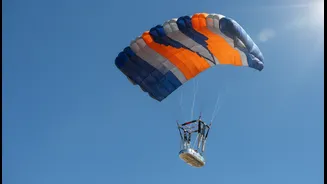
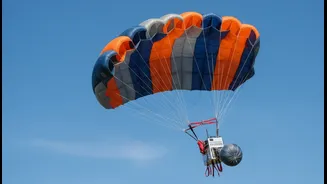
Once the parachute systems successfully pass the gruelling rocket sled trials, they graduate to the next phase: integrated airdrop tests. For these, a test article, often a mock crew module of equivalent weight, is carried to a high altitude by an Indian Air Force transport aircraft like the IL-76. These tests, such as the recent series for the Gaganyaan main parachute, are conducted over drop zones like the one in Sheopur, Madhya Pradesh. Dropped from a height of several kilometres, the entire deployment sequence is initiated in mid-air, just as it would happen during a real mission. Instruments and cameras record every millisecond, confirming that the apex cover separates, the drogue chutes stabilise the module, and the main parachutes deploy and inflate correctly to ensure a soft landing. Each successful test, from the ground-based sled to the high-altitude drops, builds confidence in the system's reliability for the first uncrewed Gaganyaan flights and, ultimately, for the safety of Indian astronauts.