



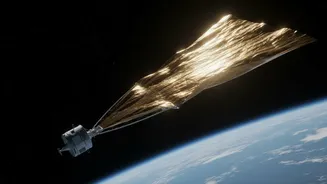
A Sailboat for the Stars
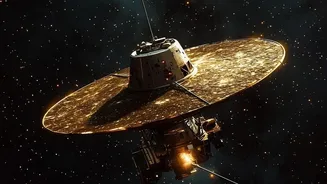
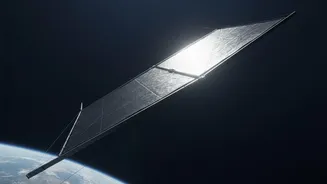
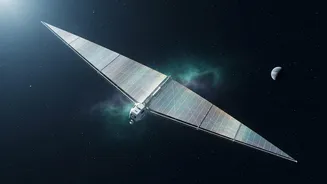
Imagine a sailboat crossing the ocean, its sails catching the wind to push it forward. A solar sail operates on a similar principle, but in the vacuum of space, its 'wind' is sunlight itself. Light is made of particles called photons. While they have
no mass, they have momentum. When a photon strikes a solar sail's vast, mirror-like surface, it transfers a tiny bit of its momentum, giving the spacecraft a gentle nudge. As the photon bounces off, it provides a second, equally small push. This force is incredibly slight—at Earth's distance from the sun, the pressure on a sail the size of a tennis court is comparable to the weight of a paperclip. Yet, in the frictionless environment of space, this constant, gentle push is all you need to start moving, and to keep accelerating.
The Power of a Gentle, Endless Push
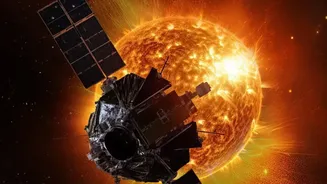
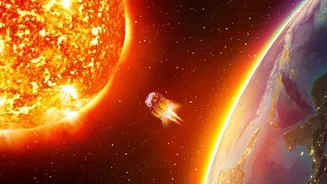
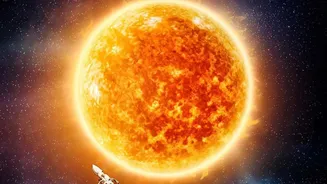
This is where solar sails earn their 'high-speed' credentials. A chemical rocket provides an enormous, violent burst of thrust for a few minutes, then coasts for the rest of its journey. In contrast, a solar sail is always accelerating. Every second of its voyage, as long as it is exposed to sunlight, it is getting pushed faster and faster. Over weeks, months, and years, this continuous acceleration can allow a solar sail craft to reach speeds that would be impossible for a conventional rocket to achieve. This makes them ideal for long-duration missions to the outer planets or even, one day, to other stars. Some concepts, known as 'extreme solar sailing', propose using a close fly-by of the sun to get a massive speed boost, potentially enabling missions to the outer solar system in months instead of many years.
Leaving the Fuel Tank at Home
The 'low-cost' part of the equation comes from one simple fact: solar sails don't need fuel. A significant portion of a traditional spacecraft's mass is its propellant. Eliminating the need for fuel, tanks, and complex engines drastically reduces the spacecraft's overall weight. A lighter spacecraft is a cheaper spacecraft to launch. This reduction in launch mass is a primary driver of cost savings, potentially by as much as 30-40%. Furthermore, the entire architecture of the mission changes. Small, cost-effective satellites, known as CubeSats, can be equipped with solar sails for ambitious interplanetary journeys—missions that would have once required budgets of hundreds of millions of dollars.
From Science Fiction to Real Missions
Solar sailing is no longer just a theoretical concept. Japan's IKAROS probe successfully flew by Venus using a solar sail in 2010. More recently, The Planetary Society's crowdfunded LightSail 2 mission, which operated from 2019 to 2022, successfully demonstrated that a small satellite could use sunlight to change its orbit around Earth. Building on these successes, NASA launched the Advanced Composite Solar Sail System (ACS3) in April 2024. This mission is testing new, lightweight carbon fiber booms that are essential for building the much larger and more efficient sails needed for future deep-space missions. Though ACS3 has encountered some issues, it successfully deployed its 80-square-meter sail, providing valuable data for the next generation of sail technology.
The Future of Interstellar Probes
While solar sails are perfect for certain missions, they aren't a replacement for all rockets. The thrust is too low to escape a planet's gravity, so they still need a traditional rocket to get into orbit. They are also most effective closer to the sun, as the light pressure diminishes with distance. However, the technology opens up entirely new mission possibilities. Scientists are exploring using them to create unique observation posts, hovering in places that would otherwise be unstable, to provide better warnings of solar storms. For truly interstellar journeys, the concept can be taken a step further. Instead of relying on the sun, powerful lasers could be aimed at a sail, pushing it to a fraction of the speed of light—a concept being explored by projects like Breakthrough Starshot.