





Why Water Is the Moon's Gold
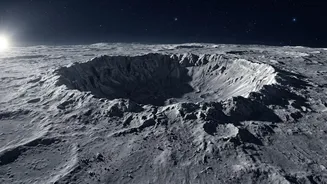
For decades, the Moon was thought to be completely dry. But missions starting in the 1990s and culminating with NASA's Lunar Reconnaissance Orbiter (LRO) confirmed the presence of water ice, especially in permanently shadowed craters at the lunar south
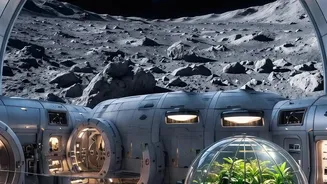
pole. This discovery was a game-changer for space exploration. Water is essential not just for astronauts to drink, but it can also be broken down into hydrogen and oxygen. These components provide breathable air and, critically, the primary ingredients for rocket fuel. Being able to 'live off the land' by harvesting local resources — a concept known as In-Situ Resource Utilization (ISRU) — would dramatically reduce the cost and complexity of long-duration missions. Instead of launching tons of water from Earth, future missions could refuel on the Moon for journeys to Mars and beyond. This makes finding usable water a top priority for NASA's Artemis program, which aims to build a sustainable 'Artemis Base Camp' on the lunar surface.
The Proof We Need
While we know water ice is there, we don't know enough to start building a base around it. Current evidence is mostly from orbiters that detected hydrogen signatures. We lack ground-truth data on its exact form, concentration, and accessibility. Is the ice mixed in as fine grains with lunar soil (regolith), or is it in thick, pure sheets? How deep is it buried? How difficult will it be to extract? Answering these questions is fundamental. The difference between mining a few ice crystals per cubic meter versus excavating solid blocks is the difference between an operational outpost and a failed investment. Before committing to a multi-billion dollar base camp location, NASA needs to be certain the resources are practical to harvest.
NASA's New Scientific Lineup
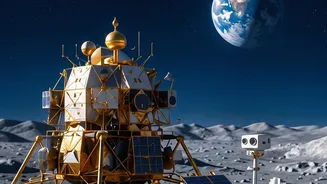
To get these answers, NASA recently selected three new payload suites through its Payloads and Research Investigations on the Surface of the Moon (PRISM) program. While all three will help prepare for a moon base, one is specifically focused on the ice question: the Depth Imager with Spectral and Color Optics (DISCO). DISCO is designed to get the first direct, on-the-ground measurements of ice hidden in 'micro-cold traps' — small, permanently shadowed areas that stay cold enough for ice to survive. It will investigate where the ice is, how much is there, and in what form it exists. The other two investigations will also provide vital context. The Lunar Environment Monitoring Station – South Pole (LEMS-SP) will act as a long-term weather and hazard station, tracking things like micrometeoroids and seismic activity. The Geophysical Investigation for Mapping Lunar Interior (GIMLI) will search for underground lava tubes near the Marius Hills Pit, which could potentially serve as natural shelters for astronauts.
From Robots to Human Boots
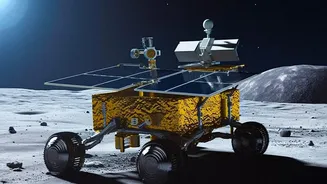
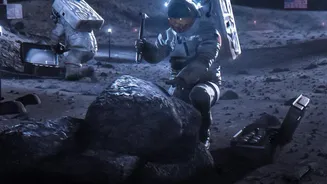
These investigations, along with rovers like VIPER (Volatiles Investigating Polar Exploration Rover), represent a methodical, robotic-first approach. VIPER, a golf-cart-sized rover, is specifically designed to prospect for ice and create the first resource maps of another world. It will carry a drill and spectrometers to analyze lunar soil at depths of up to one meter. The data gathered by VIPER and the new PRISM investigations will be used to create detailed resource maps. These maps will be essential for selecting the final landing sites and, eventually, the site for the Artemis Base Camp itself. These robotic scouts are quite literally paving the way, ensuring that when astronauts return to the Moon to stay, they arrive at a location with the proven resources needed to survive and thrive.