




The Cosmic Crime Scene
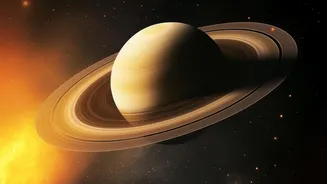
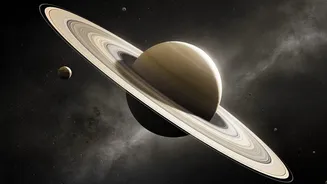
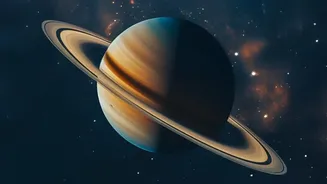
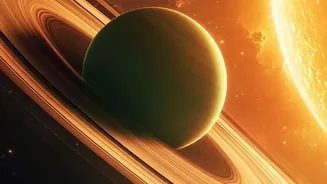
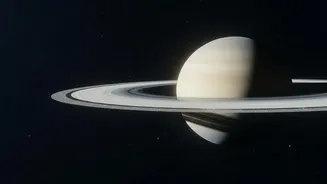
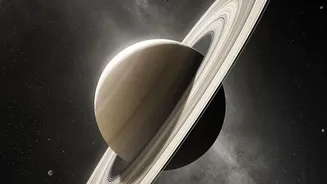
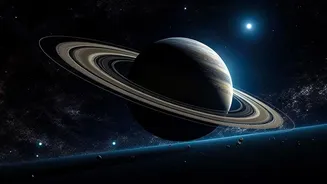
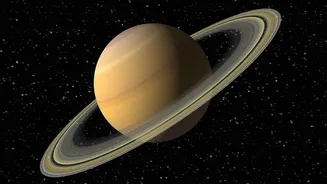
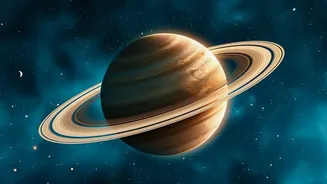
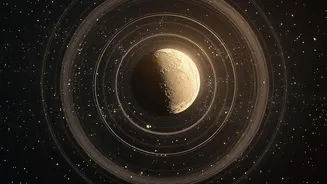
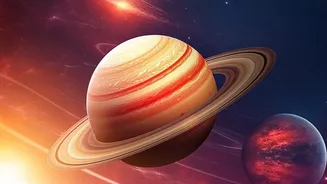
For decades, astronomers have treated Saturn's rings like a cosmic crime scene, searching for clues to answer a simple but profound question: how old are they? For a long time, the prevailing theory was that the rings were young. Based on data from NASA’s
Cassini spacecraft, which studied the planet for 13 years, scientists argued that the rings couldn't be more than a few hundred million years old. That’s incredibly young in cosmic terms, meaning they might have formed when dinosaurs still roamed the Earth. The reasoning was simple: the rings are made almost entirely of pristine water ice. If they were as old as Saturn itself (around 4.5 billion years), they should have been darkened and polluted by a constant bombardment of rocky micrometeoroids over billions of years. Their brightness suggested they were a recent addition.
The Case for 'Young' Rings Gets Stronger
The “young rings” theory is supported by a dramatic phenomenon known as “ring rain.” Observations from both the Voyager missions in the 1980s and the Cassini mission’s grand finale in 2017 confirmed that Saturn is constantly pulling material from its rings. Electrically charged ice particles are dragged along the planet's magnetic field lines and fall into its upper atmosphere. The rate of this loss is staggering; some estimates suggest Saturn loses enough water from its rings to fill an Olympic-sized swimming pool every half hour. At this rate, the entire ring system could disappear in as little as 100 million years. This ticking clock strongly implies that what we see today can't have been around forever. We may just be lucky to be alive in the brief window of cosmic history when Saturn has its glorious rings.
A New Twist in an Old Tale
Just when the scientific community was settling on the idea of young, ephemeral rings, new research has thrown a wrench in the works. A late 2024 study using computer modeling challenged the very foundation of the youth argument. Japanese-led researchers proposed that the rings might be self-cleaning. Their models suggest that when micrometeoroids strike the icy ring particles, they vaporize, and the resulting charged particles are ejected into space or pulled into Saturn, leaving little residue behind. This could mean the rings only look young and might actually be as old as the planet itself. This finding has reignited the debate, suggesting the rings could be pristine not because they are new, but because they are essentially dirt-resistant. This opens the door to the possibility that the rings are primordial, having formed alongside Saturn 4.5 billion years ago.
So, What's the Origin Story?
The age of the rings is inextricably linked to how they were born. If they are young, the most popular theory is that they formed from the debris of a large icy moon that strayed too close to Saturn and was ripped apart by the planet's immense gravity. Simulations suggest this catastrophic event could have happened just a few hundred million years ago, scattering ice into the orbit where it eventually settled into the rings we see today. Some theories even point to a dramatic collision between two former moons that shattered, creating the rings and contributing to the formation of some of Saturn’s current moons. If the rings are old, however, they are likely the leftover material from the very formation of the solar system. The debate continues, with each new piece of data adding another layer of complexity.
Why This Cosmic Debate Matters
Determining the age of Saturn's rings isn't just about a single planet. It has profound implications for our understanding of the solar system's evolution. If the rings are young, it suggests that the region around gas giants was a dynamic and sometimes violent place much more recently than we thought. It could mean planetary systems are not static, but continue to evolve and change dramatically over their lifetimes. Understanding their composition and dynamics is so crucial that NASA is now exploring ambitious new mission concepts, like PRAXIS (Planetary Rings Autonomous Exploration with In-situ Sampling), which would aim to physically touch and analyze ring particles for the first time. Such a mission could finally provide definitive answers to the questions that have puzzled astronomers since Galileo first glimpsed the planet's strange shape through his telescope.