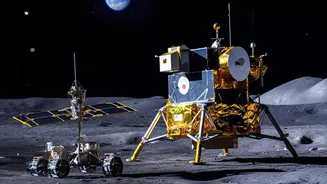


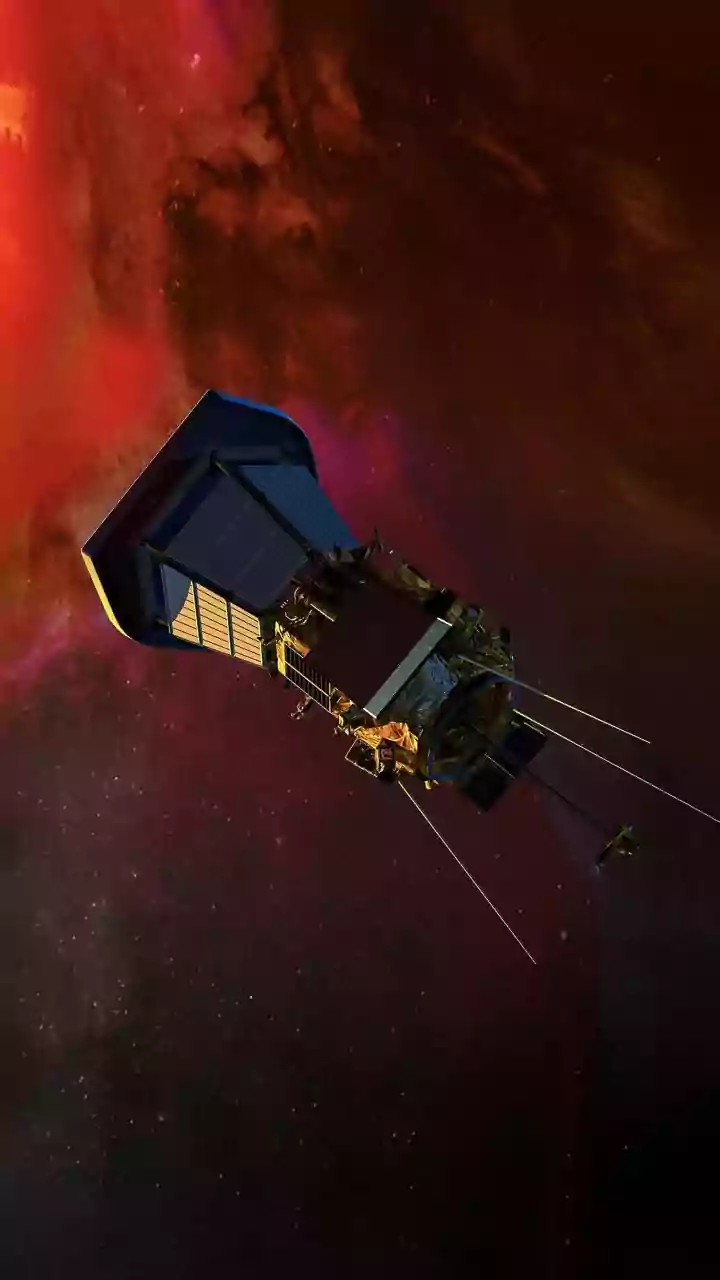





From the International Space Station to the satellites powering our daily lives, those iconic wing-like solar arrays are a constant presence. But how do they actually capture sunlight and turn it into the lifeblood of a spacecraft?
Harnessing the Sun
The fundamental process
behind a spacecraft's solar panel is the photovoltaic effect. Each panel is made of many individual solar cells, typically from materials like gallium arsenide, which is more efficient and radiation-resistant than the silicon used on Earth. When sunlight, which is made of particles called photons, strikes these cells, it transfers energy to them. This energy is just enough to knock electrons loose from their atoms, creating a flow of electricity. This process generates a direct current (DC) that serves as the raw power for the entire spacecraft.
Specialised Cells for a Harsh Environment
Solar cells destined for space are far more advanced than their terrestrial counterparts. While early satellites used silicon cells, modern spacecraft rely on multi-junction cells. These use stacked layers of different semiconductor materials, such as indium gallium phosphide, gallium arsenide, and germanium. Each layer is tuned to capture a different slice of the solar spectrum—from ultraviolet to infrared—allowing the cell to convert much more sunlight into energy. These high-efficiency cells are critical, as they need to generate enough power while keeping the size and mass of the solar arrays as low as possible for launch.
Unfolding the Arrays
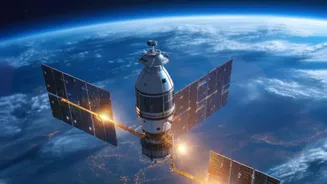
Solar arrays are far too large and delicate to be launched in their fully extended form. Instead, they are compactly folded, often like an accordion or rolled up into a 'blanket'. Once the spacecraft safely reaches orbit, ground control sends a command to deploy them. This can involve complex mechanisms with hinges, booms, and motors that carefully unfurl the arrays. To maximize power generation, most spacecraft feature sun-tracking systems. These mechanisms constantly rotate the solar arrays to ensure they are always facing the sun directly, much like a sunflower tracking the light.
Powering Through the Darkness
A satellite orbiting Earth doesn't have continuous access to sunlight. It regularly passes into the planet's shadow, an event called an eclipse, cutting it off from its primary power source. To survive these periods of darkness, the spacecraft relies on rechargeable batteries. During periods of sunlight, any excess electricity generated by the solar panels is used to charge these batteries, which are typically advanced lithium-ion or nickel-hydrogen cells designed for the rigours of space. When an eclipse occurs, the spacecraft seamlessly switches to battery power to run all its essential systems.
The Brains of the System
The flow of electricity from the solar arrays and batteries isn't a free-for-all. It's managed by a critical component known as the Power Conditioning and Distribution Unit, or PCDU. This unit acts as the 'brain' of the electrical system. It regulates the voltage from the solar panels, prevents the batteries from overcharging, and distributes the correct amount of power to all the different subsystems, from communication instruments to onboard computers and heaters. These systems are custom-designed for each mission to ensure reliability, as an electrical failure in space is almost impossible to repair.