

The Universe According to the Old Rules
For decades, our best understanding of the universe's evolution was guided by the Standard Model of Cosmology, also known as Lambda-CDM. This model was remarkably successful, explaining everything from the cosmic microwave background radiation to the large-scale
structure of galaxies we see today. According to this story, the universe started hot and dense after the Big Bang and then began a long, slow process of cooling and expansion. In this version of events, the first stars and galaxies were expected to form gradually. The early cosmos was thought to be a relatively sparse place, where small pockets of gas and dark matter slowly coalesced over hundreds of millions of years to build the first, faint 'baby' galaxies. It was a picture of steady, bottom-up construction.
Webb's Powerful Infrared Gaze
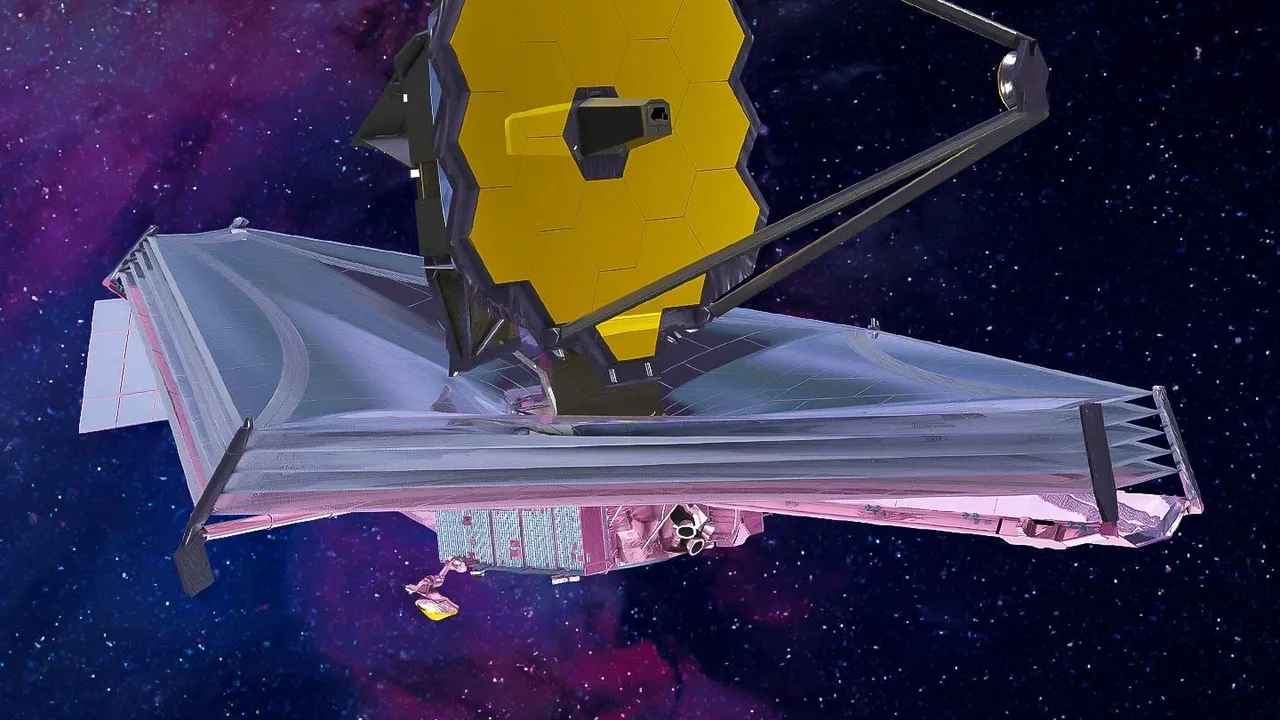
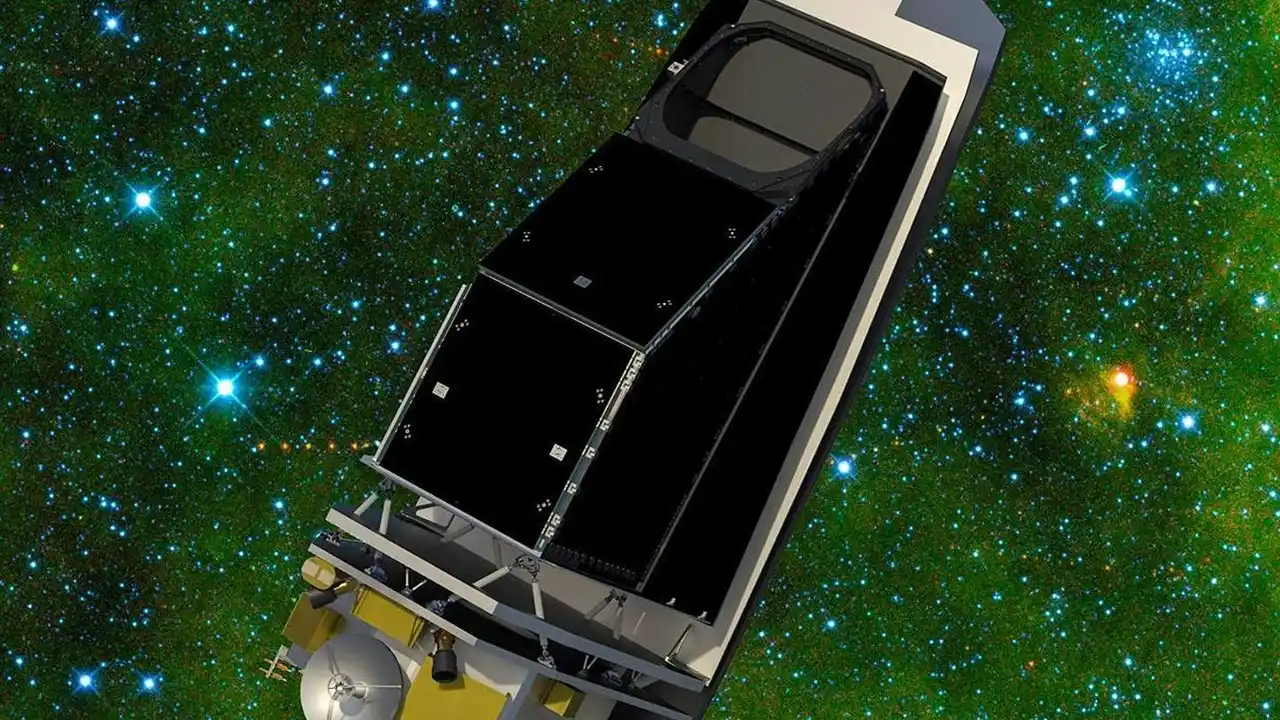
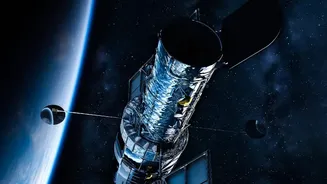
Enter the James Webb Space Telescope. Launched in 2021, its primary mission was to peer into this very era—the cosmic dawn. Webb's key advantage is its specialisation in infrared light. As the universe expands, the light from the most distant objects gets stretched into longer, redder wavelengths. Webb's giant mirror and sensitive instruments are designed specifically to capture this faint, ancient light, allowing it to see objects that are too old, distant, and dim even for the Hubble Space Telescope. This capability allows it to cut through the cosmic dust and fog of the early universe and witness the formation of the very first stars and galaxies in unprecedented detail.
Finding Giants Where Saplings Should Be
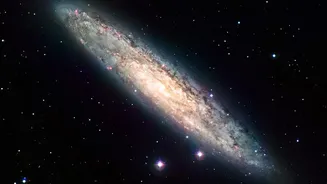
What Webb began to see almost immediately sent ripples through the astronomical community. Instead of finding a handful of small, faint, and misshapen proto-galaxies, Webb found a surprising number of bright, massive, and well-structured galaxies. Some of these giants were observed at a time when the universe was only 300 to 500 million years old—a mere 2-3% of its current age. Finding such mature galaxies so early is like finding a fully grown oak tree in a garden where you only expected to see the first few seeds sprouting. These galaxies were not just bright; some appeared to have already finished their main phase of star formation, a process known as 'quenching', which scientists didn't expect to see for billions of years.
The Cosmic Density Dilemma
This is where the idea of 'cosmic density' comes into play. The existence of so many massive galaxies so early on creates a profound puzzle. To build such large structures so quickly, the early universe must have been converting its available gas into stars with an efficiency that far exceeds what our models predicted. This implies one of two things, both of which challenge previous beliefs. Either the initial density of matter in the early universe was higher than assumed, providing more raw material for galaxy building, or the process of star formation itself was radically different and much more explosive in those early, pristine conditions. It suggests the 'factories' for making stars and galaxies were operating in overdrive from the very beginning.
A New Chapter in Cosmology
These discoveries are not 'breaking' the Big Bang theory, as some headlines have suggested. Instead, they are forcing a major rewrite of the chapters that immediately follow it. Scientists are now exploring new ideas to explain the data. Perhaps the first generation of stars were much more massive, burning brighter and seeding the cosmos with heavy elements faster than thought. Others are investigating whether early supermassive black holes played a bigger role in galaxy formation, with some theories even suggesting the direct collapse of massive gas clouds into black hole 'seeds'. These findings have sparked a vibrant and exciting period of scientific debate. The tension between the old models and Webb's new data is precisely how science moves forward.