







The Sun’s Invisible Threat
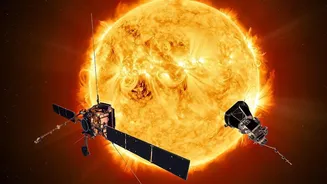
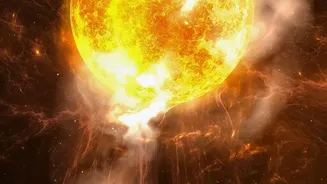
The Sun is not always the benign star it appears to be. It periodically ejects enormous clouds of charged particles and radiation in events known as coronal mass ejections (CMEs) and solar flares. When these storms are aimed at Earth, they can have serious
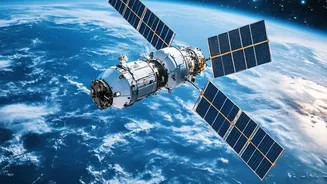
consequences for our space-based assets. The high-energy particles can damage sensitive satellite electronics, leading to malfunctions or permanent failure. Furthermore, a geomagnetic storm can heat Earth's upper atmosphere, causing it to expand. This increases the atmospheric drag on satellites in low-Earth orbit (LEO), causing them to lose altitude faster and potentially re-enter the atmosphere prematurely. A stark example occurred in February 2022, when a geomagnetic storm caused the loss of up to 40 newly launched Starlink satellites.
A Global Network of Solar Watchers
To protect against this threat, a global network of space and ground-based observatories keeps a constant watch on the Sun. In the United States, the National Oceanic and Atmospheric Administration (NOAA) and its Space Weather Prediction Center (SWPC) are at the forefront. They use a fleet of satellites, like the GOES series, to monitor the Sun for signs of an eruption in real-time. Another key asset is the Deep Space Climate Observatory (DSCOVR), positioned 1.5 million kilometers from Earth at a stable gravitational point called Lagrange Point 1 (L1). From this vantage point, DSCOVR can measure the solar wind as it rushes past, providing a crucial early warning of an incoming storm, typically about an hour before it hits Earth.
India’s Eye on the Sun: Aditya-L1
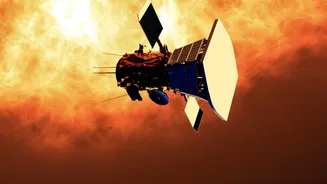
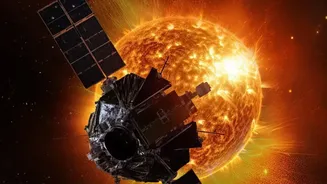
India has become a major player in solar observation with the Indian Space Research Organisation's (ISRO) Aditya-L1 mission. Also positioned at the L1 point, Aditya-L1 is India’s first dedicated solar observatory. Its suite of instruments provides crucial data on the Sun's atmosphere, solar flares, and the dynamics of space weather. Aditya-L1 has already proven its value by providing vital measurements during major geomagnetic storms, collaborating with international missions to build a more complete picture of how these events travel through space and interact with Earth's magnetic field. This enhances India's own space weather prediction capabilities and contributes significantly to the global understanding of solar phenomena.
From Data to Actionable Warnings
When a solar eruption is detected, scientists use complex computer models, like the WSA-Enlil system, to predict if the CME will hit Earth and, if so, when it will arrive and how intense it will be. Based on these forecasts, the SWPC issues a series of alerts, watches, and warnings, much like terrestrial weather forecasting. A 'Watch' is issued hours or days in advance when conditions are favourable for a storm, while a 'Warning' indicates a storm is imminent or already in progress. These alerts are sent to government agencies, power grid operators, airlines, and, critically, satellite operators. The alerts use a scale to denote severity for radio blackouts (R1-R5), solar radiation storms (S1-S5), and geomagnetic storms (G1-G5).
A Satellite Operator’s Playbook
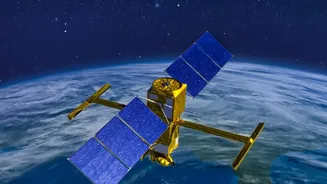
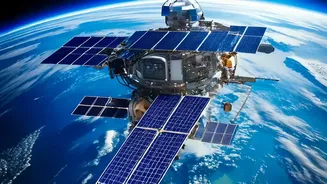
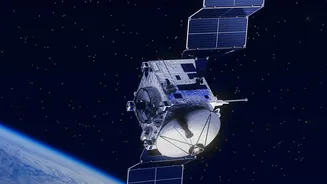
Once a warning is received, satellite operators have a playbook of actions to mitigate potential damage. For satellites in high orbits, the primary threat is radiation. Operators might command a satellite to enter a protective 'safe mode', shutting down non-essential systems and orienting the spacecraft to present its most shielded side to the incoming particle storm. For satellites in LEO, the main danger is increased atmospheric drag. In response to a storm warning, some operators may preemptively raise their satellites' orbits to create a larger buffer against orbital decay. In some cases, operators may need to temporarily suspend non-essential manoeuvres to conserve fuel and maintain control as the atmosphere thickens. These proactive measures are essential to extending the operational life of a satellite and ensuring the continuity of the services it provides.