

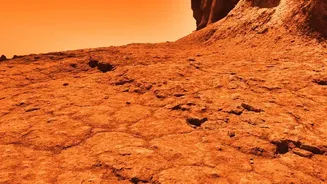
Welcome to Hell, Bring a Camera
Imagine a world where the atmospheric pressure is over 90 times that of Earth at sea level, equivalent to being nearly a kilometer deep in our oceans. Now, imagine the temperature is a blistering 465 degrees Celsius, hot enough to melt lead. This isn't
a sci-fi dystopia; it's the everyday reality on the surface of Venus. Adding to the misery are clouds of sulfuric acid. For decades, these conditions have made our planetary neighbour one of the most difficult places in the solar system to explore. While Soviet Venera probes in the 1970s and 80s managed to survive for brief periods—Venera 13 famously lasted 127 minutes and sent back the first colour photos from the surface—the goal now is to build technology that can last much longer and do much more. Future missions, like NASA's DAVINCI, are designed to plunge through this hostile atmosphere, taking detailed measurements and images along the way. The primary challenge remains the same: how do you build a sophisticated scientific instrument, like a camera, that can survive this hellscape long enough to reveal the secrets hidden beneath the clouds?
Engineering for the Extreme
Conventional electronics and optics don't stand a chance on Venus. The silicon-based semiconductors in our everyday devices fail quickly at such high temperatures. This has forced engineers to rethink how to build a camera from the ground up. One approach, used for descent probes like DAVINCI, is to build a heavily shielded, pressure-sealed vessel. This titanium sphere acts like a miniature submarine, protecting the delicate instruments inside from the crushing pressure and searing heat for the duration of its descent. However, this is a short-term solution, offering a couple of hours at most. For longer-term missions, scientists are developing entirely new types of electronics using wide-bandgap materials like silicon carbide, which are inherently more resistant to extreme heat. NASA is actively developing circuits capable of operating at Venus's ambient temperature for months. The camera's lens and sensor are another major hurdle. The lens must be made from special materials that won't crack or darken under the intense heat and radiation, while the sensor needs to function without the active cooling required by most high-performance cameras. These innovations are not just for space; technologies developed for Venus could find applications in extreme environments on Earth, like inside jet engines or deep-earth drilling operations.
The Geological Story We Want to Read
So why go to all this trouble? Because Venus has a story to tell, and it's a critical one for understanding our own planet. Venus and Earth are similar in size and composition, suggesting they may have had similar starts. Scientists want to know if Venus ever had oceans and a more temperate climate. The camera is a key tool in this investigation. As a probe like DAVINCI descends, its Venus Descent Imager (VenDI) will capture high-resolution images of a mountainous, geologically complex region called Alpha Regio. Scientists believe these highland "tesserae" might be the oldest parts of Venus's surface, analogous to Earth's continents. By imaging the rocks, geologists can look for clues about their composition and formation. Are they volcanic, like much of Venus's plains, or are they a different type of rock that may have formed in the presence of water? The images will provide a crucial bridge between the low-resolution radar maps we have from orbiters like Magellan and the ground-level data from past landers.
More Than Just Pretty Pictures
The cameras on future Venus missions are far more than simple point-and-shoot devices. Orbiters like NASA's VERITAS and ESA's EnVision will use specialized imagers that see in the infrared spectrum. These instruments can peer through the thick carbon dioxide clouds in specific wavelength "windows" to map the rock types on the surface. Different minerals emit heat at different infrared wavelengths, so by creating a compositional map, scientists can distinguish between different types of volcanic rock and search for more exotic materials. These orbital cameras also search for the thermal signatures of active volcanism—hotspots that could indicate fresh lava flows. Meanwhile, a descent imager's job is to provide context. By photographing the landscape from a bird's-eye view during its final kilometers of descent, it can reveal layering in the rock, erosion patterns, and other features that tell a story of geological processes over time. This multi-faceted approach, combining orbital mapping with high-resolution descent imaging, is designed to give us our first truly comprehensive picture of the geology of another terrestrial world.