



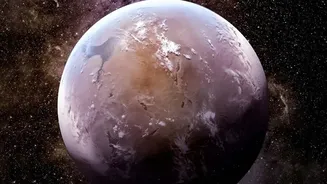
Venus: The Hostile Sibling
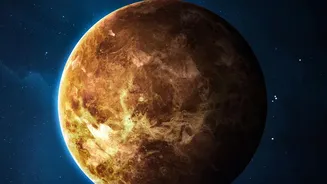
In our solar system, no two planets are more alike in size, mass, and origin than Earth and Venus. Yet, they could not be more different. Venus is the hottest planet, with a surface temperature that can melt lead, an atmosphere 90 times denser than Earth's,
and clouds of sulfuric acid. This stark contrast has turned Venus into one of the most compelling puzzles for planetary scientists. Understanding how and why Earth's twin evolved into a toxic, runaway greenhouse world is not just an academic question; it serves as a crucial case study for understanding planetary habitability and the long-term evolution of our own climate. Past missions have only scratched the surface, leaving fundamental questions about its geology and atmosphere unanswered.
The Great Atmospheric Mysteries
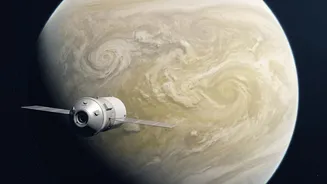
The headline mystery of Venus is its 'super-rotating' atmosphere. The entire atmospheric layer circles the planet in just four Earth days, a staggering 60 times faster than the planet's own sluggish 243-day rotation. The forces driving these hurricane-speed winds remain a major puzzle that scientists believe may be linked to thermal tides—massive atmospheric waves generated by the sun's intense heat on the planet's dayside. Beyond its speed, the atmosphere's composition is full of enigmas. In its lower layers, the immense pressure and heat squeeze carbon dioxide into a state that behaves more like a hot liquid than a gas. There are also unexplained chemical anomalies and cloud properties that have led to speculation, including the unconfirmed detection of phosphine gas, a potential biosignature.
Enter Shukrayaan-1: India's Venus Explorer
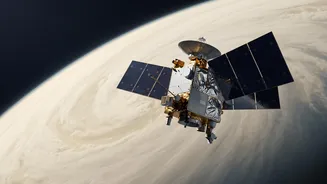
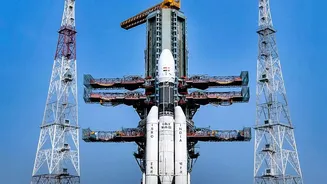
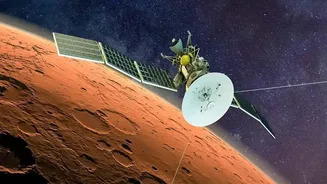
Following the historic successes of the Chandrayaan and Mangalyaan missions, the Indian Space Research Organisation (ISRO) is setting its sights on Venus. Formally approved in September 2024, the Shukrayaan-1 orbiter is scheduled to launch on March 29, 2028, aboard a powerful LVM-3 rocket. After a journey of 112 days, it is expected to enter a large elliptical orbit around Venus on July 19, 2028. From this vantage point, the mission will spend over four years conducting a comprehensive investigation of the planet. Its primary goals are to map the Venusian surface and subsurface, study the complex atmospheric dynamics, and analyse the interaction between the planet's ionosphere and the solar wind.
A Toolkit of Specialised Sensors
To peer through the planet's opaque clouds, Shukrayaan-1 will carry a suite of 19 advanced scientific instruments. A key instrument is a high-resolution Synthetic Aperture Radar (SAR), which can map the surface in detail regardless of weather or darkness, seeking evidence of active volcanoes and other geological features. It will also deploy a ground-penetrating radar for the first-ever look at the planet's shallow subsurface stratigraphy. For atmospheric analysis, the mission includes instruments developed through international collaboration. The VIRAL instrument, a joint effort with Russia and France, will analyse atmospheric chemistry, while the VISWAS payload, featuring a Swedish-built sensor, will study how the solar wind affects the Venusian atmosphere. These sensors will work together to create a holistic picture of the planet's processes.
What India Hopes to Discover
Shukrayaan-1 is more than just another space mission; it's a quest for answers that could reshape our understanding of how planets like our own are formed and evolve. By mapping volcanic activity, ISRO hopes to determine if Venus is still geologically active today. By studying its extreme atmosphere, scientists aim to build better models for climate change, providing a cautionary tale of a greenhouse effect gone wild. For India, the mission cements its position as a leading power in space exploration, capable of undertaking complex interplanetary journeys. It builds on a track record of cost-effective and scientifically valuable missions, attracting collaboration from space agencies across the globe, including those from Sweden, Germany, and Russia.