
The Goldilocks Promise
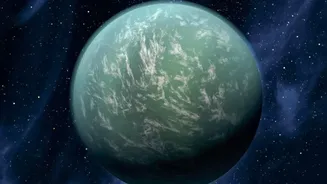
In the grand search for life beyond our solar system, the first filter is often the 'habitable zone'. This is the orbital ring around a star where conditions are just right—not too hot and not too cold—for liquid water to potentially exist on a planet's
surface. Given that liquid water is a key ingredient for life as we know it, finding a rocky planet in this zone is a major milestone. Discoveries like the planets in the TRAPPIST-1 system or the world Wolf 1069 b caused a stir for exactly this reason. Three of TRAPPIST-1's seven planets reside in its habitable zone. These initial findings are what get a planet placed on a list of worlds that might, just might, be a little like Earth.
The Star's Fiery Temper
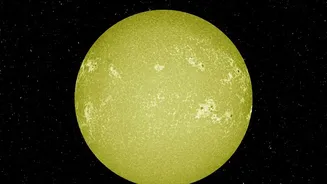
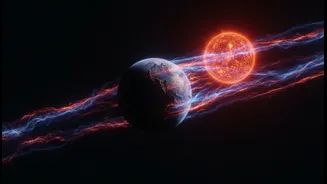
A perfect location, however, means little if the neighbourhood is dangerous. Many stars, particularly the small, cool red dwarfs that are common targets for planet searches, are notoriously active. Unlike our relatively stable Sun, these stars can erupt with frequent and powerful stellar flares—intense bursts of radiation and charged particles. The TRAPPIST-1 star, for instance, is known to flare frequently, sometimes multiple times a day. This stellar 'space weather' can be devastating for any nearby planets, especially since the habitable zones around these cooler stars are much closer in, putting orbiting worlds directly in the line of fire.
An Atmosphere Under Siege
The primary concern with a highly active star is its effect on a planet's atmosphere, which is essential for regulating temperature and shielding the surface from harmful radiation. A powerful stellar flare can slam into a planet with a torrent of high-energy X-rays, ultraviolet radiation, and charged particles. Over time, this constant bombardment can physically strip a planet's atmosphere away, blowing it out into space. This process, known as atmospheric escape, could turn a once-promising world into a barren, airless rock, much like what is thought to have happened to Mars in our own solar system. Studies have shown that even frequent, lower-energy flares can have a significant cumulative impact on atmospheric erosion.
The Detective Work Begins
This is why, after the initial excitement of a habitable-zone discovery, scientists pivot to scrutinizing the star itself. Using powerful instruments like the James Webb Space Telescope and various ground-based observatories, they meticulously monitor the star's light over time. They look for the sudden, sharp brightening that indicates a flare, and by analysing the light's spectrum, they can determine the flare's temperature and energy. This painstaking work allows them to build a profile of the star's activity. Is it a calm, stable star like Wolf 1069, which shows a welcome absence of intense activity? Or is it a volatile star like TRAPPIST-1, whose frequent outbursts make habitability a much more complex question? This characterization is a critical step in sorting contenders from pretenders.
A More Complex Picture of Habitability
The focus on stellar activity highlights a crucial evolution in the search for life. Habitability is not a simple checklist item; it is a complex interplay of dozens of factors. A planet needs more than just the right temperature. It needs a stable orbit, a protective magnetic field, and, critically, a parent star that doesn't regularly sterilize its surface and blast away its atmosphere. Very recently, astronomers celebrated the detection of an atmosphere on a rocky planet called LHS 1140 b, a major breakthrough because it proved such worlds can retain their atmospheres. This process of vetting the star is therefore essential. It narrows the field, allowing researchers to focus their precious telescope time on the systems that offer the most stable and promising environments for life to potentially take hold.