


A Sweet Discovery in Deep Space
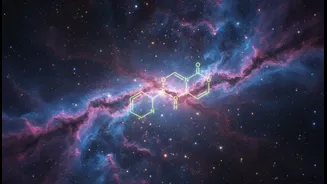
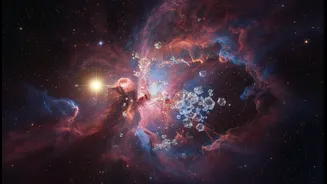
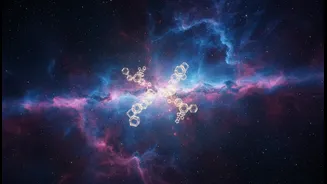
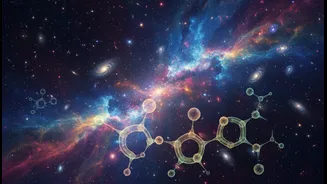
An international team of astronomers has made a landmark discovery, identifying the first true sugar molecule in the vastness of interstellar space. The molecule, called erythrulose, is a four-carbon sugar and was found in a massive molecular cloud named
G+0.693-0.027, located about 26,700 light-years from Earth near the center of the Milky Way. This isn't just any chemical; on Earth, erythrulose is found in things like raspberries and is even used in some self-tanning products. Using highly sensitive radio telescopes in Spain, researchers detected the faint chemical fingerprint of erythrulose, matching its specific radio signals to those measured in a laboratory. While other sugars like glucose and ribose have been found in meteorites that have landed on Earth, this is the first time a sugar has been directly observed in the interstellar medium—the raw material from which stars and planets are born.
Why This Particular Sugar Matters
Sugars are fundamental to life as we know it. They act as energy sources and, crucially, form the structural backbone of DNA and RNA, the molecules that carry genetic information. The discovery of erythrulose is particularly exciting because it helps address a major puzzle in origin-of-life research: how the first sugars formed on early Earth. Laboratory experiments simulating early Earth conditions have struggled to produce sugars in sufficient quantities. The presence of erythrulose in space supports the theory of an external origin—that key ingredients for life were delivered to Earth by comets and asteroids billions of years ago. Furthermore, some scientists propose that before RNA and DNA, life may have used a simpler genetic material called Threose Nucleic Acid (TNA), which is built on a four-carbon sugar backbone. In the presence of water, erythrulose can be converted into threose, making it a direct chemical link to a possible precursor of the first genetic code.
An Unexpected Chemical Recipe
One of the most surprising aspects of the discovery is how much erythrulose was found compared to its simpler cousins. The research team found that erythrulose is at least eight times more abundant than any three-carbon sugars, which were not detected at all. This challenges the long-held assumption in astrochemistry that complex molecules form incrementally, by adding one carbon atom at a time. Instead, computer models suggest that erythrulose forms more efficiently on the icy surfaces of interstellar dust grains. It appears to be created from the combination of simpler two-carbon molecules, bypassing the three-carbon stage entirely. This new understanding of cosmic chemistry suggests that the pathways to creating biologically relevant molecules might be more varied and efficient than previously thought.
The Ingredients, Not the Cake
While finding a key sugar in a cosmic cradle of stars is a monumental step, it is crucial to manage expectations. This discovery does not mean we have found alien life. Rather, it means we have found a naturally occurring factory for one of life's essential ingredients. Think of it like finding a bag of flour in a vast, empty kitchen. You have a key component for baking a cake, but you don't have the cake itself, let alone the baker. This finding is about prebiotic chemistry—the chemical processes that occurred before life emerged. It shows that complex molecules that are useful for biology can form in the harsh environment of space, without any biological help. This strengthens the argument that the building blocks of life could be common throughout the galaxy, potentially seeding other young planets as they form.
What Comes Next for Astrobiology
This discovery provides astrobiologists with both a new tool and a renewed sense of direction. By successfully identifying the spectral signature of erythrulose, scientists now have a tested method to search for other, even more complex sugars in space. The next major target is ribose, the five-carbon sugar that forms the backbone of RNA. Finding ribose in the interstellar medium would be another giant leap, further bridging the gap between simple interstellar chemistry and the complex molecules required for life. The detection of erythrulose opens a new chapter in the study of our cosmic origins, allowing scientists to trace the journey of life's ingredients from deep space all the way to nascent planets, bringing us one step closer to understanding how life may have begun on Earth and whether it could exist elsewhere.