


Your Eyes Are a Time Machine
It sounds like science fiction, but it’s the simple, beautiful reality of physics. Light, though the fastest thing in the universe, still takes time to travel across the vast emptiness of space. The distance it travels in one year is called a light-year.
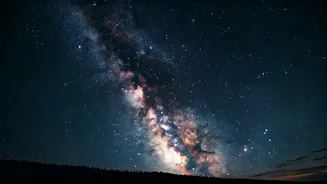
So, when we say a star is 100 light-years away, we mean the light we are seeing tonight left that star 100 years ago. Think about it this way: you are seeing the star not as it is right now, but as it was a century ago. Every sparkle in the night sky is a postcard from the past. The farther away the object, the older the message. This simple fact transforms stargazing from a casual glance into a profound connection with cosmic history.
Ancient Stories Written in Starlight
Many of the bright stars you can spot from India are sending us light from significant moments in our own history. Take Sirius, the brightest star in our night sky, also known as Vyadha. It is about 8.6 light-years away. The light you see from it tonight began its journey around the time India’s Mars Orbiter Mission, Mangalyaan, was entering Mars' orbit. Look for the star Vega (Abhijit), part of the Summer Triangle, which is about 25 light-years away. Its light started travelling towards Earth when Sachin Tendulkar was just making his mark on international cricket. Go further to Polaris (Dhruva), the North Star, which is over 300 light-years away. When its light began its journey, the Mughal Empire was in its powerful prime under rulers like Shah Jahan. You aren’t just seeing a star; you are seeing an echo from the era of the Taj Mahal.
Gazing Billions of Years into the Past
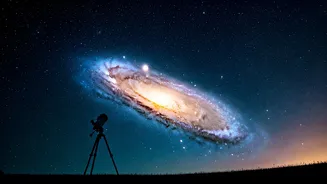
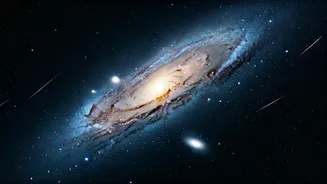
It doesn't stop with stars. With a bit of luck and a dark sky, you can see objects whose light is far, far older. The Pleiades star cluster, a beautiful, tight-knit group of stars also known as the Krittika Nakshatra, is about 440 light-years away. The light we see left them during the time of the Gupta dynasty's decline. And for the ultimate journey back in time, there is the Andromeda Galaxy. On a very dark, clear night, far from city lights, it is visible to the naked eye as a faint, fuzzy patch of light. That smudge is our nearest major galactic neighbour, and it is 2.5 million light-years away. The light reaching your eye tonight started its journey when early human ancestors, not modern humans, roamed the Earth. You are seeing a fossil, made of light, from a time before human history even began.
How to Best View These Ancient Lights
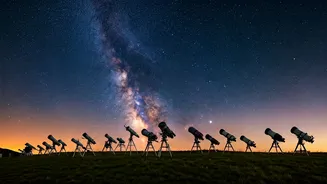
You don’t need an expensive telescope to become a time traveller. The best tool you have is patience and a dark sky. The biggest obstacle for most of us in India is light pollution from our cities. If you can, travel a short distance away from the city centre to a place with fewer streetlights. Give your eyes at least 15-20 minutes to fully adapt to the darkness. Avoid looking at your phone screen, as its bright light will ruin your night vision. You will be amazed at how many more stars appear once your eyes have adjusted. Simple binoculars can dramatically enhance the view, revealing the colours of stars and the sheer number of them in clusters like the Pleiades. There are also many free stargazing apps that can help you identify what you’re looking at just by pointing your phone at the sky.