


Venus: Earth's Hostile Twin
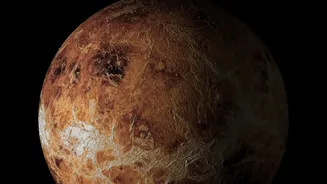
Often called Earth's twin due to its similar size and density, Venus is anything but hospitable. It's the hottest planet in our solar system, with surface temperatures that can melt lead, a crushing surface pressure over 90 times that of Earth's, and an atmosphere
thick with carbon dioxide and clouds of sulphuric acid. Yet, scientists believe Venus may have once been more like Earth, possibly with vast oceans. A runaway greenhouse effect is thought to have boiled its oceans away, turning it into the inferno it is today. Understanding how and why this happened is a key scientific driver, offering crucial lessons about planetary evolution and climate change that are relevant to our own world.
ISRO's Ambitious Toolkit
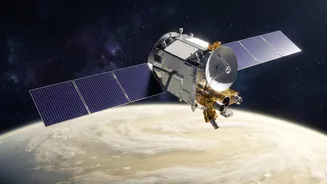
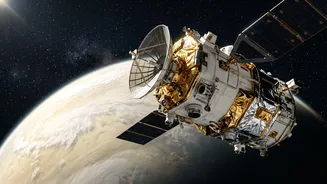
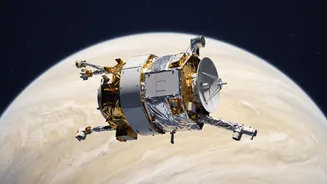
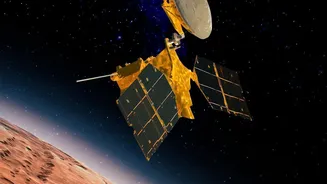
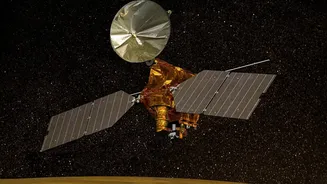
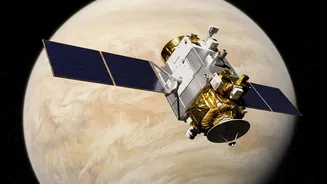
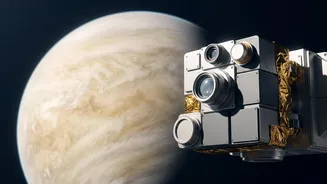
To study this hostile world, ISRO's Venus Orbiter Mission, unofficially named Shukrayaan-1, will be equipped with a suite of sophisticated instruments. The mission, which received formal government approval in September 2024 for a March 2028 launch, will carry a payload of about 100 kg. The flagship instrument is a high-resolution Synthetic Aperture Radar (SAR), which can peer through the dense clouds to map the planet's surface in far greater detail than previous missions like NASA's Magellan. For the first time ever on a Venus mission, it will also carry a ground-penetrating radar to investigate the planet's subsurface geology. These tools will search for evidence of active volcanoes and lava flows, which could help explain how Venus maintains its incredibly thick atmosphere.
Decoding the Corrosive Clouds
Much of the mission's focus is on the atmosphere itself. The orbiter will carry a range of sensors to study the composition, dynamics, and chemistry of the Venusian air. This includes instruments developed in collaboration with international partners, such as the Venus InfraRed Atmospheric gases Linker (VIRAL), a joint project with Russia and France. This sensor will analyze the chemical makeup of the clouds, which are a major driver of the planet's extreme climate. Other instruments will measure the thermal structure of the atmosphere, map cloud movements, detect lightning, and study how the solar wind interacts with Venus's upper atmosphere, stripping away particles into space.
The Search for Answers
The data gathered by these sensors aims to answer fundamental questions. Scientists want to understand the 'super-rotation' of Venus's atmosphere, which circles the planet in just four Earth days. They also want to investigate the planet's extreme greenhouse effect, which serves as a stark warning for climate change on Earth. The mission may also re-examine the controversial 2020 detection of phosphine gas in the Venusian clouds. On Earth, phosphine is associated with biological processes, and while the initial finding has been debated, Shukrayaan's instruments could provide a more definitive answer on its presence. By providing a comprehensive, global view of the planet, ISRO's mission will fill in gaps left by previous explorations that had limited coverage.
India's Next Interplanetary Leap
The Venus Orbiter Mission marks India's next great leap in planetary exploration, following the celebrated successes of Chandrayaan (Moon) and Mangalyaan (Mars). It's not just a scientific quest but also a significant technological demonstration. For the first time, ISRO will use an aerobraking technique, dipping the spacecraft into the upper atmosphere to gradually lower its orbit and conserve fuel. A successful mission will cement India's position as a major player in space science, contributing vital knowledge to the global understanding of our solar system and the conditions that make a planet habitable. The mission is seen as a major step towards achieving India's long-term space vision, which includes putting astronauts on the Moon by 2040.