






The Fiery Plunge and the First Hurdle
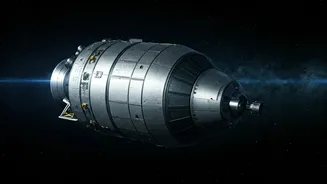
After the service module performs its de-orbit burn, it separates from the crew capsule, which then begins its perilous descent. Plunging into Earth's atmosphere at thousands of kilometres per hour, the capsule uses atmospheric drag as its first brake,
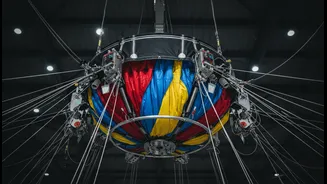
with a protective heat shield absorbing the immense heat. But even after this initial slowdown, the capsule is still moving too fast for a safe landing. This is where the parachute system comes into play, a ten-part symphony of deceleration designed to guarantee the safety of the astronauts inside. The entire sequence is initiated by two apex cover separation parachutes, which are pyrotechnically fired to jettison the protective cover that shields the main parachute compartment.
The Stabilisers: Drogue Parachutes
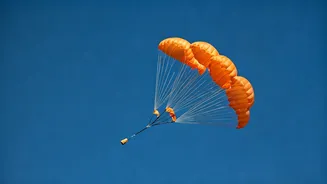
Once the apex cover is clear, the first critical braking stage begins. Two conical, ribbon-style drogue parachutes are deployed. These are not designed for the final slowdown but have a crucial job: to stabilise the capsule as it tumbles through the air at supersonic speeds and to drastically reduce its velocity. Think of them as the initial speed brakes. ISRO has rigorously tested these drogue parachutes, which are ejected from the capsule using mortars, to ensure they can withstand the immense initial shock and perform reliably under a wide range of flight conditions. They are designed to slow the module enough for the next, much larger set of parachutes to deploy safely without being torn apart.
The Pilot's Role and Main Deployment
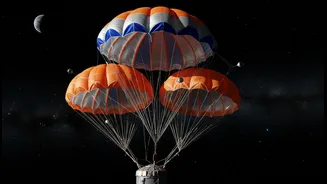
After the drogue parachutes have done their job and are jettisoned, the capsule is now at a more manageable subsonic speed. The next step in this perfectly timed sequence is the deployment of three small pilot parachutes. Their sole purpose is to pull the three massive main parachutes out of their compartments in a controlled manner. This is a critical transition phase; a tangled or failed main parachute would be catastrophic. By using pilot chutes, ISRO ensures that the main canopies are extracted cleanly and are properly oriented before they begin to inflate, providing the final and most significant stage of deceleration for the Gaganyaan module.
The Giant Canopies for a Gentle Splashdown
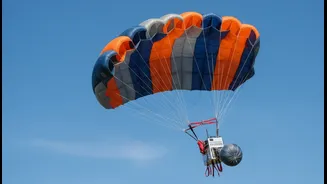
The final stage involves three massive main parachutes, the largest ever produced in India. These are the workhorses that slow the heavy crew module from a rapid descent to a gentle splashdown speed. When they first deploy, they are 'reefed,' meaning they are only partially opened by using special cords to manage the immense initial strain. This prevents the shock of sudden deceleration from damaging the canopy or the capsule. Once the initial shock is absorbed, the reefs are cut, and the parachutes inflate to their full diameter, slowing the capsule to a velocity safe enough for a soft landing in the ocean, where recovery teams will be waiting.
Testing for Absolute Perfection
A system this critical cannot be left to chance. ISRO, in collaboration with DRDO and the Indian Armed Forces, has conducted an exhaustive series of tests to validate every component of this parachute array. These include numerous Integrated Main Parachute Airdrop Tests (IMAT), where full-scale parachutes are dropped from Indian Air Force aircraft at high altitudes to simulate mission conditions. Recent tests, like the fifth in the IMAT series, have successfully qualified the main parachutes under the maximum expected load conditions, giving ISRO confidence in the system's performance and reliability ahead of the first uncrewed Gaganyaan (G1) mission.