





An Accidental Experiment
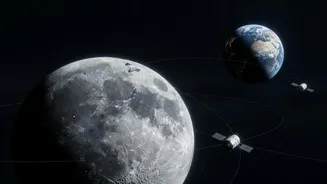
On August 5, 2026, the upper stage of a SpaceX Falcon 9 rocket is expected to slam into the lunar surface at roughly 5,400 miles per hour. This piece of space hardware isn't on a mission; it's a leftover from a January 2025 launch that sent two commercial
landers toward the Moon. After deploying its payload, the four-ton rocket stage was left in a chaotic orbit. A combination of solar activity and gravitational forces has now put it on a definitive collision course with the Moon, an outcome confirmed by independent astronomers and NASA's Jet Propulsion Laboratory. While the impact is unintentional, astronomers are treating it as a valuable, unplanned experiment.
What Scientists Hope to Learn
A deliberate impact is not a new idea. In 2009, NASA's LCROSS mission intentionally crashed a probe into a permanently shadowed crater to confirm the presence of water ice. That mission was a success, revealing that the lunar soil holds useful materials. This upcoming impact, however, offers a different kind of opportunity. Because researchers know the object's mass, speed, and trajectory in advance, they can use the event to calibrate their models of impact physics. The collision will act as a natural excavator, creating a new crater estimated to be about 60 feet wide and throwing a plume of lunar dust and rock outward. Studying this ejecta can reveal secrets about the composition and geology of the Moon's surface in that specific region, near a feature known as Einstein crater.
A Ringside Seat for Science
Although the crash itself won't be visible from Earth with the naked eye, a global network of scientists is preparing to watch. NASA will use ground-based telescopes and space-based assets, such as the Lunar Reconnaissance Orbiter (LRO), to try and observe the event in real-time. The goal is to capture images of the initial flash and the subsequent debris cloud. Analyzing how the plume of ejected material behaves will provide crucial data, helping to refine models that predict how impact events unfold. This information is not just academic; it has practical applications for understanding the risks that meteoroid and debris strikes could pose to future lunar bases and astronauts.
The Growing Issue of Space Junk
While scientists are excited about the research opportunity, the event also highlights the growing problem of space debris. This Falcon 9 stage is one of many human-made objects left drifting in space after their missions are complete. As more missions from different nations and private companies venture to the Moon, the potential for accidental impacts will only increase. This crash serves as a tangible reminder of the need for sustainable practices in space exploration, including planning for the responsible disposal of rocket stages and old satellites. The impact may provide valuable scientific data, but it also underscores the importance of keeping the lunar environment as pristine as possible for future generations of explorers and scientists.