



Untangling Time on Venus
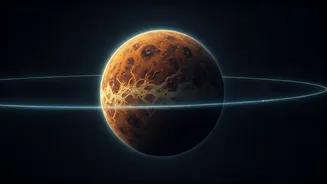
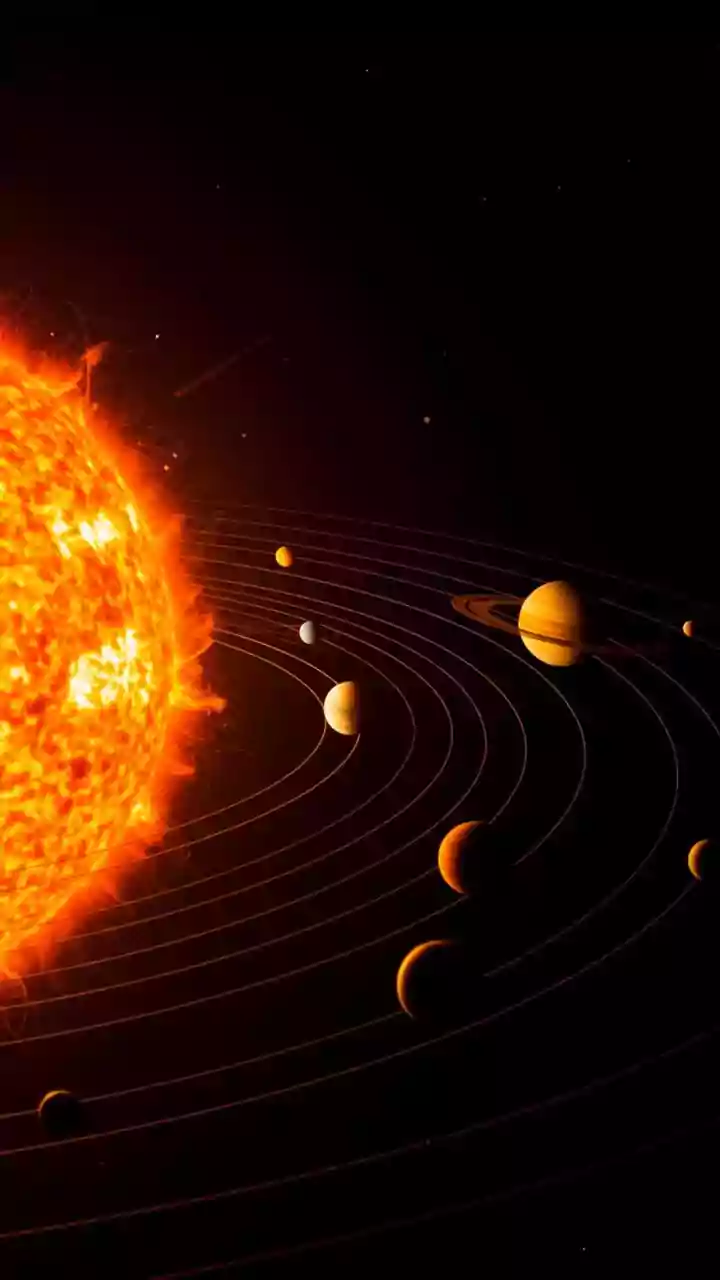
To understand this cosmic puzzle, we first need to clarify what we mean by a 'day' and a 'year'. A year is the time it takes a planet to complete one full orbit around the Sun. For Venus, this journey takes about 225.5 Earth days. A day, however, can
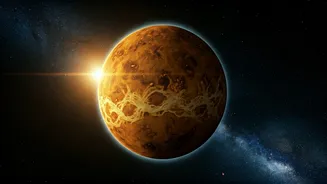
be measured in two ways. There’s the sidereal day, which is the time it takes for a planet to complete one full 360-degree rotation on its axis. On Venus, this takes an incredibly long 243 Earth days. And right there is the core of the paradox: its day (one full spin) is longer than its year (one full orbit). If you were standing on Venus, the planet would complete its trip around the Sun before it finished a single rotation.
The Slowest, Strangest Day
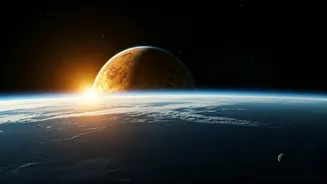
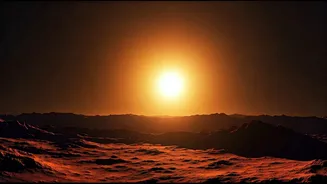
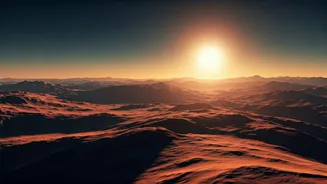
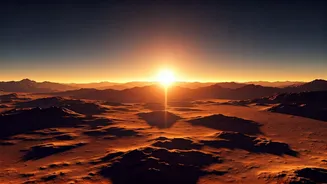
But it gets even stranger. Venus rotates 'backwards', a phenomenon known as retrograde rotation. Every other planet in our solar system (except Uranus, which is tilted on its side) spins counter-clockwise on its axis. Venus spins clockwise. This retrograde motion, combined with its slow speed, creates another type of day: the solar day. This is the time it takes for the Sun to appear in the same position in the sky—what we on Earth think of as 'one day', from sunrise to sunrise. Because Venus is rotating backward as it moves forward in its orbit, one sunrise to the next takes about 117 Earth days. So, while a single spin takes 243 days, you would actually experience roughly two sunrises and two sunsets in a single Venusian year.
Why is Venus So Odd?
Scientists don't have a definitive answer, but there are two leading theories to explain Venus’s sluggish, backward spin. The first is the 'giant impact' hypothesis. Early in its history, billions of years ago, a massive planet-sized object may have slammed into Venus. A head-on collision could have slowed its original rotation to a crawl, while a slightly off-centre impact could have been powerful enough to completely reverse its direction of spin. The second theory points to Venus's own atmosphere. Venus has the thickest, densest atmosphere of any rocky planet, creating an immense surface pressure 90 times that of Earth's. Scientists believe that this heavy atmosphere, locked in a gravitational tug-of-war with the planet's core and the Sun's gravity, may have acted like a powerful brake over billions of years, slowing the rotation and eventually causing it to reverse.
Earth’s Hellish Twin
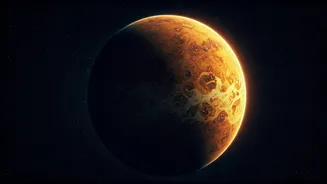
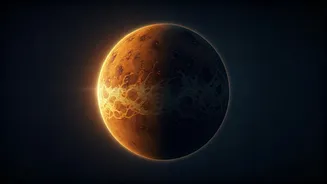
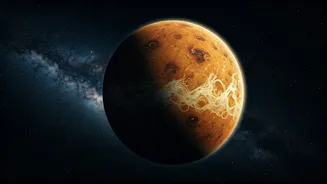
This strange rotation is intrinsically linked to why Venus is often called 'Earth's hellish twin'. Despite being similar in size and mass, it couldn’t be more different. The ultra-slow rotation means there's no strong global magnetic field like Earth's, which leaves the planet exposed to harsh solar winds. Furthermore, the long days and nights contribute to extreme temperature dynamics. The planet is wrapped in a thick blanket of carbon dioxide, which has triggered a runaway greenhouse effect, trapping heat and making its surface the hottest in the solar system—around 465° Celsius, hot enough to melt lead. The slow spin ensures there is little temperature variation between day and night, keeping the entire planet permanently scorching hot.