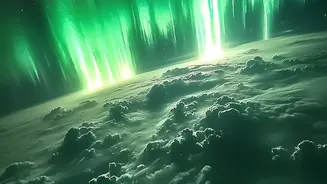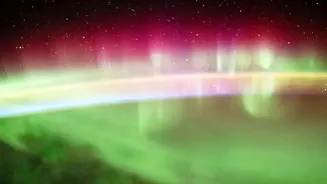




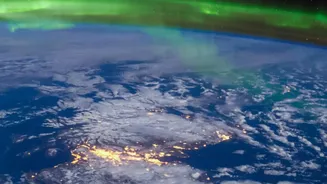

The shimmering curtains of an aurora are one of nature's most dazzling displays. We've long known these light shows are linked to solar storms that can threaten our power grids, but a new study complicates this picture in a fascinating way.
An Electrifying Connection
To understand
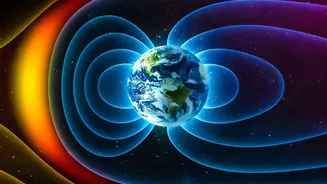
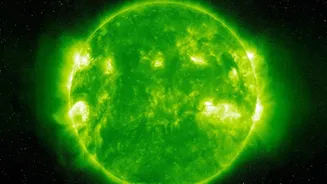
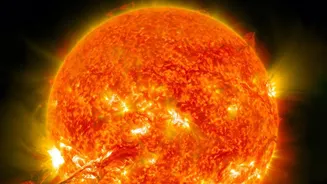
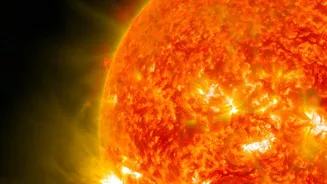
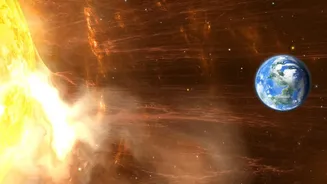
the risk, we first need to look at the cause. Auroras are born from the solar wind, a constant stream of charged particles from the sun. When a major solar event, like a coronal mass ejection (CME), sends a billion-ton cloud of plasma hurtling toward Earth, it can cause a geomagnetic storm. This storm energises particles in our magnetosphere, which then collide with gases in the upper atmosphere, creating the beautiful colours we see as auroras. But this isn't just a light show. The same process that creates the aurora also drives powerful electrical currents in the ionosphere. These currents induce another type of current on the ground, called geomagnetically induced currents, or GICs. These quasi-DC currents are the real troublemakers, capable of flowing into long conductors like power lines and pipelines.
The Danger Lurking in the Wires
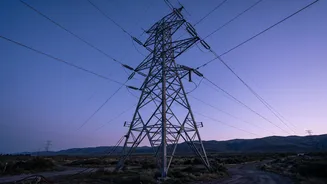
Power grids are designed to run on alternating current (AC). When GICs sneak into the system, they can cause serious problems. These rogue currents can saturate the magnetic cores of high-voltage transformers, causing them to overheat. In a best-case scenario, this leads to protective systems tripping and causing localised blackouts. In a worst-case scenario, it can lead to permanent damage to these massive, expensive, and hard-to-replace transformers. The most famous example is the March 1989 storm that knocked out power for nine hours across Quebec, Canada. More recently, the strong G5 storm in May 2024, which produced auroras visible at unusually low latitudes, stressed grids worldwide and caused some disruptions in Sweden and for satellite operations.
A Surprising Disconnect
For years, the common assumption has been straightforward: a brighter, more active aurora means a stronger geomagnetic storm, which in turn means a greater risk from GICs. But new research is showing that this isn't the whole story. While auroras are a visual indicator that a storm is happening, the brightness of the display is not a reliable proxy for the intensity of the ground-level currents. Studies now show that the most dangerous conditions for power grids are created not just by the strength of the magnetic disturbance, but by its rate of change. A rapidly fluctuating magnetic field can induce powerful GICs even if the aurora overhead isn't the most spectacular ever seen. Conversely, a very bright but stable aurora might be associated with less hazardous ground currents.
What Really Puts Our Grid at Risk?
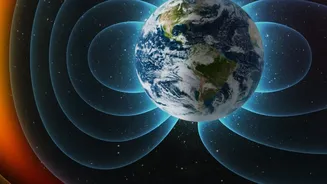
The key factor is the specific characteristics of the solar wind and how it interacts with Earth's magnetic field. This includes the orientation of the interplanetary magnetic field (IMF). When the IMF turns southward, it connects more efficiently with Earth's magnetosphere, allowing more energy to be transferred. Furthermore, the type of solar event matters. Interplanetary shocks can create sharp, rapid changes in the magnetic field that are particularly effective at inducing GICs. Local conditions on Earth also play a huge role. The underlying geology and soil conductivity can dramatically alter the strength of GICs from one location to another just tens of miles apart. A region with more resistant rock will force induced currents to seek an easier path—like a nearby power line.
Towards Smarter Forecasting
This new understanding is crucial for protecting our increasingly tech-dependent society. Instead of just looking for a bright aurora, space weather forecasters are now using advanced models that incorporate solar wind data, magnetic field orientation, and local geological information to produce more specific risk assessments. Machine learning systems can now provide location-specific risk estimates for individual substations 30–60 minutes before a potential impact. Utilities are also deploying new hardware, such as neutral blocking devices, which are designed to stop GICs from entering transformers in the first place. These efforts move us beyond simply watching the skies and towards a more proactive, physics–based approach to mitigating the invisible threats of space weather.