


A Mission of Two Halves
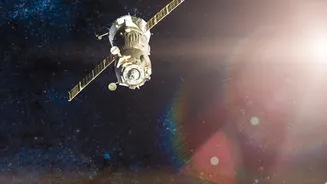
Launched in 2018, BepiColombo is an ambitious collaboration between the European Space Agency (ESA) and the Japan Aerospace Exploration Agency (JAXA). The mission is named after Italian scientist Giuseppe "Bepi" Colombo, who was instrumental in understanding
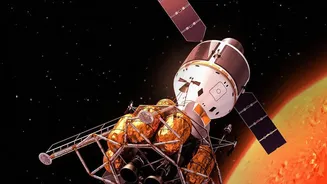
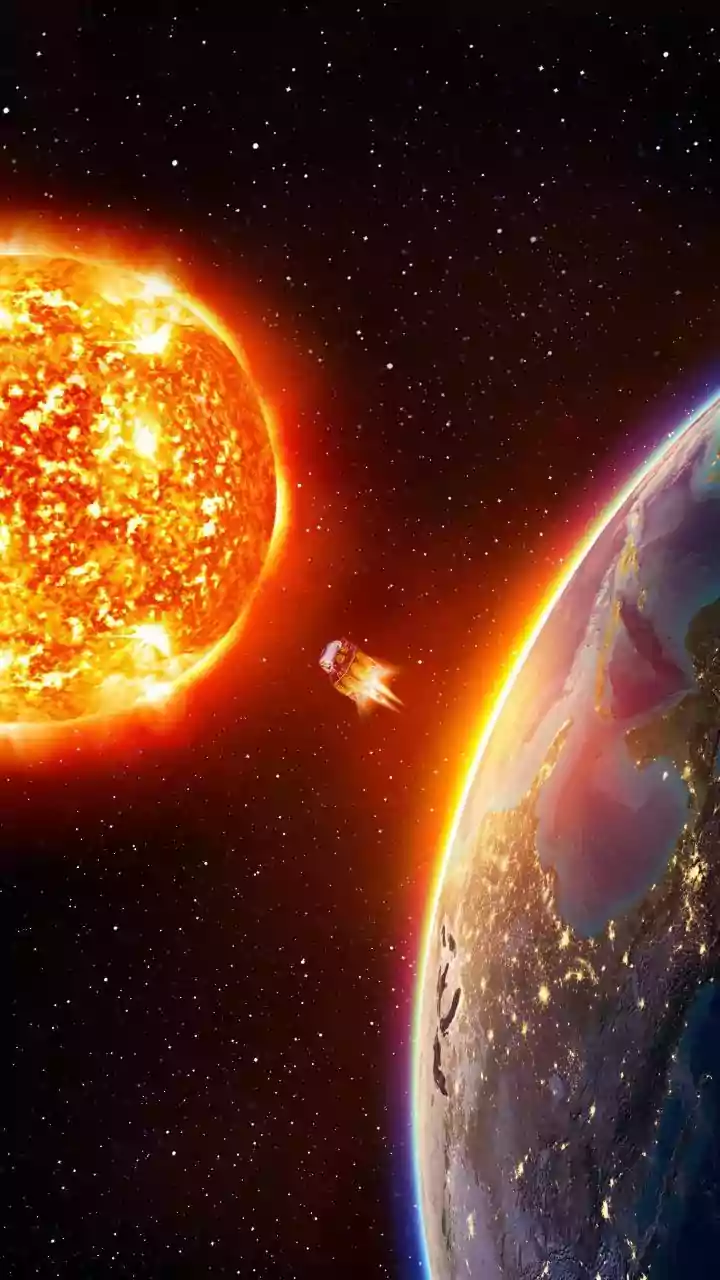
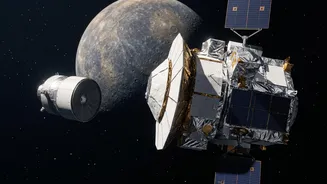
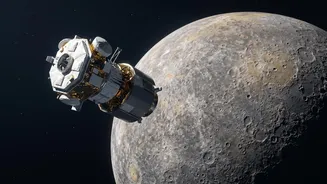
Mercury's unique rotation. Getting to Mercury is incredibly difficult due to the Sun's immense gravitational pull. After a long journey involving nine planetary flybys for gravity assists, the mission is now in its final approach phase. Its propulsion module separated on September 3, 2026, leaving two science orbiters on track to be captured by Mercury's gravity in November 2026. The mission's core concept is to use two spacecraft in complementary orbits to study the planet and its environment simultaneously, something no previous mission has done.
ESA’s Orbiter: The Planetary Mapper
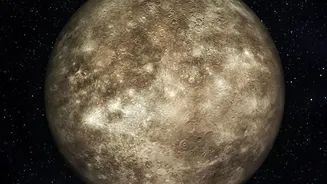
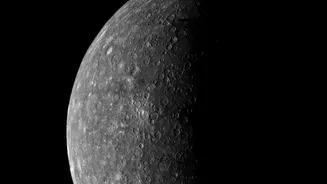
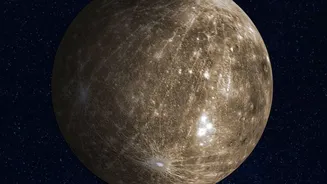
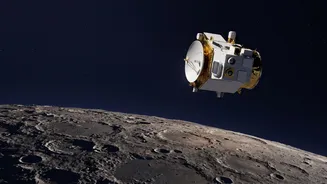
The European-built Mercury Planetary Orbiter (MPO) is designed to be the ultimate cartographer of Mercury. Its main job is to study the planet itself, from its surface to its deep interior. The MPO is equipped with a suite of 11 advanced instruments, including cameras, spectrometers, and a laser altimeter. These tools will create detailed global maps of Mercury's geology, determine the mineral and chemical composition of its crust, and investigate strange features like the mysterious 'hollows'—small, shallow depressions unique to the planet. The orbiter will also precisely measure Mercury's gravity field to learn more about its surprisingly large iron core, which makes up a huge portion of the planet's radius. By flying in a low, tight polar orbit, the MPO will get an unprecedented close-up view, even searching for signs of water ice in permanently shadowed craters at the poles.
JAXA’s Orbiter: The Magnetic Field Investigator
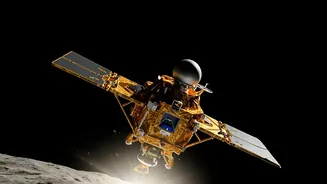
The Japanese-built Mercury Magnetospheric Orbiter (MMO), nicknamed Mio, has a very different but equally crucial task: to study the space around Mercury. Unlike Earth, Mercury has a weak but significant magnetic field, and it’s battered by intense solar wind due to its proximity to the Sun. Mio is designed to investigate this dynamic and harsh environment. As a spinning spacecraft, its five instrument packages can scan the entire surrounding area. Its primary goal is to understand the structure and origin of Mercury's magnetic field and how it interacts with the constant stream of particles from the Sun. Mio will study the planet's magnetosphere—the magnetic bubble around it—and its extremely thin atmosphere, called an exosphere. The data will help scientists understand planetary magnetic fields in general and how planets so close to their stars evolve.
Stronger Together: Solving Mercury’s Puzzles
The genius of the BepiColombo mission lies in its two-orbiter approach. By having Mio and the MPO in different orbits at the same time, scientists can distinguish between phenomena happening inside the planet and those caused by external forces like the solar wind. For example, when the MPO measures Mercury's magnetic field from its low orbit, Mio's simultaneous measurements from a higher, more elliptical orbit will provide context on the solar wind's interference. This allows for a much cleaner and more accurate picture of the planet's intrinsic magnetic field. This dual-perspective science is essential for answering some of the biggest questions about Mercury: Why is it so dense? What generates its magnetic field? And what processes shape its surface and tenuous atmosphere? This collaborative observation will provide a complete and holistic view of the planet that a single spacecraft could never achieve.