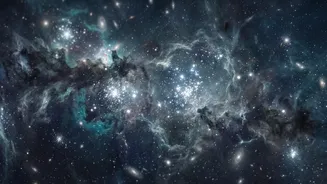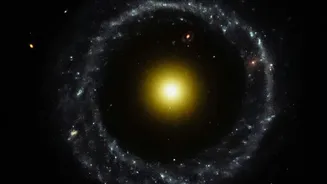

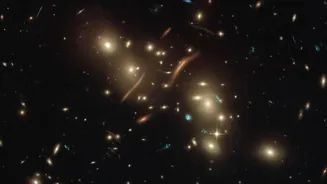
For decades, we’ve been confident the universe is 13.8 billion years old. But what if that story is wrong? A new study suggests our cosmic timeline needs a major revision, potentially doubling the age of everything we see.
Our Universe's Accepted Story
For nearly a century, our understanding
of the universe has been built on a powerful and elegant framework. This story begins 13.8 billion years ago with the Big Bang. It tells us the cosmos started as an infinitely hot, dense point and has been expanding ever since. This framework, known as the Lambda-CDM model, has been incredibly successful. It explains the leftover radiation from the Big Bang (the cosmic microwave background), the formation of the first light elements like hydrogen and helium, and the large-scale structure of galaxies we see today. To make the model work, however, scientists had to introduce two mysterious ingredients: dark matter and dark energy. Together, these are thought to make up a staggering 95% of the universe, yet they remain invisible and undetected, their existence inferred only by their gravitational effects.
A Cosmic Wrinkle in Time
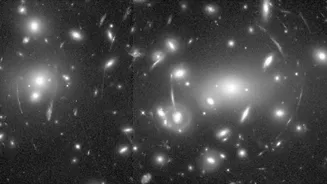
The Lambda-CDM model has been the bedrock of cosmology, but recently, cracks have begun to appear. A major source of this tension comes from the James Webb Space Telescope (JWST). Peering deep into cosmic history, the JWST has discovered galaxies that are surprisingly massive and mature just a few hundred million years after the Big Bang. According to the standard timeline, there simply shouldn't have been enough time for these 'impossible' galaxies to form. It's like finding a fully grown oak tree in a field where you only planted a seed last week. These discoveries have put cosmologists in a bind, forcing them to question whether the standard model is incomplete or if something more fundamental is wrong.
An Alternative Cosmic Clock
This is where a new, provocative study from the University of Ottawa enters the picture. Led by researcher Rajendra Gupta, a new model challenges the very foundations of the standard timeline. This alternative framework is called the CCC+TL model, which combines two ideas: 'Covarying Coupling Constants' and 'Tired Light'. The theory suggests that the fundamental forces of nature might not be constant and could have changed over time. It also resurrects the 'tired light' idea, which proposes that light loses energy as it travels across vast cosmic distances. The mind-bending conclusion of this model is that the universe might be 26.7 billion years old, nearly twice the age predicted by the standard model. In this scenario, those 'impossible' early galaxies suddenly have plenty of time to grow and mature.
A Universe Without The 'Dark'
The implications of this nonstandard model are profound. By stretching the universe's age to 26.7 billion years, it not only solves the puzzle of the early massive galaxies but also does something even more radical: it potentially eliminates the need for dark matter and dark energy. In the CCC+TL model, the phenomena we attribute to these mysterious substances are instead explained by the evolving physical constants and the effects of tired light. According to Gupta, the model successfully matches several key observations, such as the rotation of galaxies and the abundance of elements in the early universe, without needing to invent invisible components. It's a dramatic simplification of the cosmos, but one that requires us to throw out some of our most cherished assumptions.
The Next Chapter for Cosmology
It's important to note that the CCC+TL model is still a highly unconventional proposal. The Lambda-CDM model remains the dominant framework because it successfully explains a vast range of astronomical data. Many cosmologists are skeptical and believe the tensions in the standard model might be resolved with more subtle tweaks or a better understanding of galaxy formation. However, the new theory makes testable predictions. It suggests that even more distant and mature galaxies should exist beyond what the JWST has currently observed. Future observations will put this radical idea to the test. Whether it proves to be a dead end or a revolutionary new path, this new study highlights the vibrant and ongoing debate at the heart of science. It’s a reminder that our understanding of the universe is not a finished story, but a detective novel with many chapters yet to be written.