







A World Without Weather
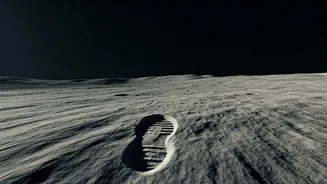
On Earth, a footprint is a fleeting thing. Wind scours it, rain washes it away, and plants grow over it. Our planet is a dynamic, living system constantly erasing the marks we make. The Moon, however, is the complete opposite. It’s an almost perfect vacuum
with virtually no atmosphere. This means there is no wind to blow the dust around and no water to turn the surface into mud. The footprints left by the 12 Apollo astronauts who walked on the Moon between 1969 and 1972 are preserved in a static, silent environment. The lunar dust, known as regolith, is a fine, powdery substance. When an astronaut stepped on it, the particles were compacted and settled into a shape that has remained undisturbed for over half a century.
The Slow Eraser of a Million Years
So, if there’s no weather, what could possibly erase them? The answer comes from space itself. The Moon is constantly being bombarded by micrometeorites—tiny particles of rock and dust, often no bigger than a grain of sand, hurtling through the solar system. This process, known as 'space weathering' or 'gardening,' is the only significant form of erosion on the lunar surface. Over immense timescales, this gentle but relentless rain of tiny impacts slowly churns the top layer of the regolith. Scientists estimate that the process is incredibly slow, eroding the surface at a rate of about 1-2 millimetres every million years. Because the footprints are a few centimetres deep, calculations suggest they could remain visible for several million years. They won't be as sharp as they are today, but their ghostly outline will persist, a testament to our brief visit.
An Accidental Museum
The footprints aren't the only human artifacts on the Moon. The Apollo landing sites are essentially accidental museums, time capsules of 20th-century technology and culture. In total, humans have left behind nearly 200,000 kilograms of material. This includes scientific instruments, like seismometers and laser reflectors that are still used by scientists on Earth today. It also includes the descent stages of the lunar modules, three lunar rovers, and 96 bags of human waste. More personal items were also left behind. Apollo 16 astronaut Charles Duke left a framed photo of his family. The American flags planted by the crews are also still there. Though satellite imagery suggests they are likely bleached white by decades of unfiltered solar radiation and may have been knocked over by the blast from the ascent engines, their fabric, like the footprints, is slowly being broken down by the harsh environment, not by weather.
Preserving Our Lunar Heritage
As humanity prepares to return to the Moon with NASA's Artemis program and missions from other nations, the question of preservation has become urgent. These historic sites are not protected by any international treaty in the way heritage sites are on Earth. There are concerns that future lunar missions—robotic or crewed—could accidentally disturb or destroy these invaluable records of human achievement. In response, NASA has established a set of voluntary guidelines, recommending that future missions keep a safe distance from the Apollo sites. This includes creating 'no-fly zones' to prevent lander exhaust from blowing dust over the artifacts. The goal is to treat these locations with the respect they deserve, preserving them for future generations who may one day visit them as historical monuments.