

A Not-So-Perfect Circle
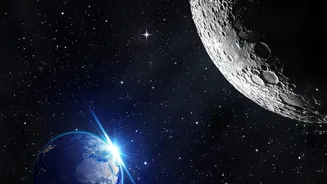
The first thing to understand is that the Moon’s orbit isn't a perfect circle. It’s an ellipse, like a slightly squashed circle. Because of this, the Moon's distance from Earth is in constant flux. During its roughly 27-day journey around our planet,
it reaches a closest point, called perigee, and a farthest point, called apogee. At perigee, the Moon can be about 226,000 miles away. At apogee, it can be more than 251,000 miles distant. That's a difference of over 25,000 miles—more than the entire circumference of the Earth. This variation is the main reason why the Moon’s distance is never truly identical day to day, let alone throughout its arc.
The Great Moon Illusion
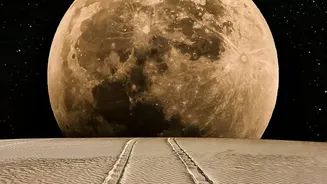
So if the Moon’s distance changes, why does it often look biggest when it's rising or setting on the horizon? This is a powerful trick of the mind known as the Moon Illusion. For thousands of years, people have observed that a low-hanging Moon appears enormous compared to when it's high overhead. But it’s not real. If you were to measure it, its angular size is the same. The most widely accepted explanation is that our brain uses cues on the horizon—trees, buildings, mountains—to judge distance and scale. When the Moon is near these familiar objects, our brain perceives it as being much farther away than the objects themselves and, to compensate, makes it look huge. When it's high in the empty sky, there are no reference points, so our brain perceives it as being closer and, therefore, smaller.
A Spinning Perspective
Even during a single night, the headline’s claim doesn't hold up. In fact, the Moon is actually physically closer to you when it's directly overhead than when it is on the horizon. It seems counterintuitive, but the geometry is simple. When you stand on the surface of the Earth, you are about 4,000 miles from its center. When the Moon is rising or setting, it's at its orbital distance. But as the Earth rotates and the Moon passes directly overhead, you are carried 'up' toward it by the radius of the Earth. This brings you several thousand miles closer than you were when it was on the horizon. So, contrary to the Moon Illusion that makes it look bigger on the horizon, it is physically smallest in your sky at that time because it's farther away.
The Long, Slow Goodbye
There's one more layer to this celestial dance. On a much grander timescale, the Moon is slowly moving away from Earth. The gravitational pull the Moon exerts on Earth creates our ocean tides. The friction from this tidal bulge, dragged ahead by Earth’s rotation, actually transfers a tiny bit of rotational energy from the Earth to the Moon. This energy boosts the Moon into a slightly higher orbit. Scientists using laser reflectors left on the lunar surface by Apollo astronauts have measured this retreat with incredible precision: the Moon is drifting away from us at a rate of about 1.5 inches per year. It’s a tiny amount, but over billions of years, it has significantly changed the Earth-Moon system.