


The Problem with Dust
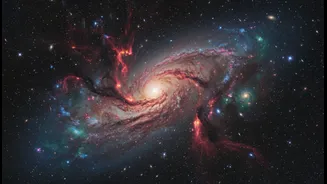
Cosmic dust, composed of tiny particles of rock and soot, is both a building block and a barrier in the study of the universe. While it's a key ingredient for forming new stars and planets, it also forms immense, opaque clouds that block our view. Visible
light and even ultraviolet light from young, hot stars gets absorbed by these dusty veils, making entire galaxies appear dim, reddish, or sometimes completely invisible to telescopes like Hubble. For decades, this has led to a biased understanding of the universe, as our census of galaxies has been limited to those that are not shrouded in dust. Astronomers have long theorized that these 'dark' galaxies were out there, but seeing inside them was a monumental challenge.
Peering Through the Veil with Infrared
The game changed with the advent of powerful infrared telescopes, most notably the James Webb Space Telescope (JWST). Unlike visible light, infrared light can pass through thick clouds of dust with much greater ease. What’s more, the dust that absorbs starlight heats up and re-radiates that energy as a faint, infrared glow. By tuning into these longer wavelengths, JWST can effectively see what the dust is hiding. Recent observations of the galaxy Centaurus A, for example, have demonstrated this capability spectacularly. Where Hubble saw only a thick, dark lane of dust bisecting the galaxy, Webb’s infrared eyes pierced through it to reveal a densely packed tapestry of individual stars.
A Monster Hiding in Plain Sight
Discoveries are rewriting what we know about the early universe. One such object, named AzTECC71, appeared as a faint blob to ground-based telescopes and was completely invisible to Hubble. But with JWST, astronomers confirmed it was a 'dusty star-forming galaxy' from nearly a billion years after the Big Bang, churning out hundreds of new stars every year. According to Jed McKinney, a researcher involved in the discovery, the fact that something so extreme is barely visible with our most powerful telescope suggests a whole population of galaxies has been hiding from us. This implies the early universe may have been far dustier than our models predicted.
Rewriting Cosmic History
These findings are more than just pretty pictures; they have profound implications for our understanding of galactic evolution. Astronomers now believe that these dusty star-forming galaxies could be a crucial, missing link in the story of the cosmos. They may represent a transitional phase, connecting the very first, bright galaxies with the later, 'quiescent' or dead galaxies that have ceased forming stars. The presence of so many active, hidden galaxies in the early universe challenges existing models and suggests that cosmic history may need a rewrite. Each new observation allows scientists to piece together a more complete timeline of how galaxies, including our own Milky Way, grew and evolved over billions of years.