

A Planet of Mysteries
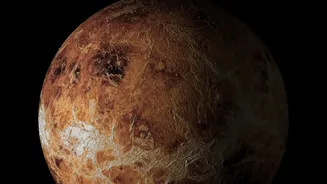
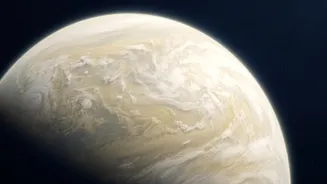
Venus presents a profound scientific puzzle. Though similar in size to Earth, it evolved into a hellish world with crushing pressure and surface temperatures hot enough to melt lead. Its atmosphere is a suffocating blanket of carbon dioxide and clouds
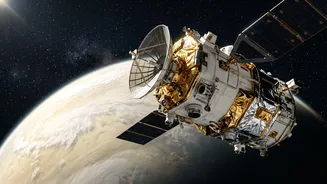
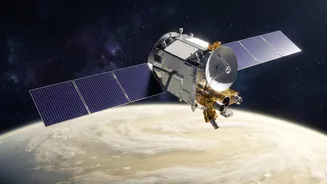
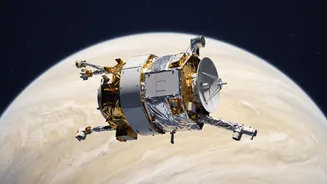
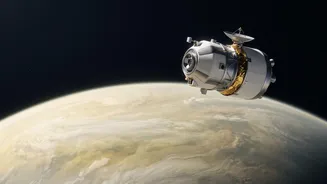
of sulfuric acid. For decades, scientists have also been intrigued by mysterious dark patches in the upper clouds that absorb huge amounts of ultraviolet (UV) radiation. Understanding what this ‘unknown UV absorber’ is, how the planet’s weather works, and why it became so inhospitable are key goals of modern planetary science. India’s Shukrayaan mission, formally approved in September 2024 and targeting a 2028 launch, is designed to tackle these very questions head-on.
Seeing Through the Haze
The headline instrument for studying Venus is a radar system. Because visible light cannot penetrate the dense cloud cover, radar is essential for mapping the surface. Shukrayaan will be equipped with a high-resolution Synthetic Aperture Radar (SAR), which is capable of imaging the planet’s surface geology, including potential active volcanoes and lava flows, with a resolution up to four times better than NASA's Magellan mission from 1989. Crucially, the mission also plans to carry a ground-penetrating radar, a world-first for Venus exploration. This instrument will allow scientists to study the subsurface stratigraphy, or rock layers, for the first time, offering clues about the planet’s geological history.
Decoding the Cloud Chemistry
To understand the clouds themselves, Shukrayaan will carry a host of instruments designed to analyse their composition and dynamics. A suite of spectrometers will observe the atmosphere in different wavelengths, from infrared to ultraviolet. One such instrument, the Venus Surface Emissivity & Atmospheric Mapper (VSEAM), will study the cloud structure and look for hotspots related to volcanism. The Venus Thermal Camera (VTC) and Venus Cloud Monitoring Camera (VCMC) will map thermal emissions and track cloud movements, helping to unravel the mystery of the planet's super-rotating atmosphere, where winds blow faster than the planet itself spins. These tools will work together to create a comprehensive profile of the Venusian atmosphere.
The Search for Answers and Life
A key Indian payload will be a Spectro-Polarimeter (VASP) which, along with other spectrometers, will investigate the identity of the unknown UV absorber. This mysterious substance has puzzled scientists for a century, with recent theories suggesting it could be iron-bearing minerals like ferric chloride. The orbiter will also carry international payloads, including the Venus InfraRed Atmospheric gases Linker (VIRAL), a joint French-Russian instrument. VIRAL is particularly significant as it can detect specific atmospheric gases. This could help investigate the controversial 2020 detection of phosphine in Venus's clouds, a gas that on Earth is associated with anaerobic life, raising tantalising questions about the potential for microbial organisms in the more temperate upper cloud layers.
Studying the Solar Interaction
Beyond the clouds and surface, Shukrayaan will study how Venus interacts with its space environment. Unlike Earth, Venus has a very weak magnetic field, leaving its upper atmosphere vulnerable to being stripped away by the solar wind—a constant stream of charged particles from the Sun. Instruments like the Venusian Neutrals Analyser (a collaboration with Sweden) and the Venus Ionospheric and Solar Wind Analyser (VISWAS) will measure this interaction directly. By studying how Venus lost its atmosphere and water over billions of years, scientists hope to better understand how Earth-like planets evolve and what makes our own world so uniquely habitable.