







The Shadow Dance of Planet Hunting
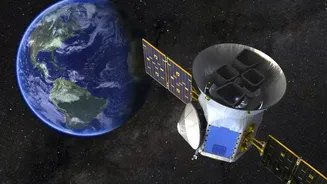
To understand how a planet can 'disappear', we first need to know how we find them. Most of the thousands of known exoplanets have been discovered using the 'transit method'. This technique relies on telescopes like NASA's Transiting Exoplanet Survey
Satellite (TESS) to stare at distant stars and watch for tiny, periodic dips in their brightness. That dip is a tell-tale sign that a planet is passing, or transiting, in front of its star from our point of view, blocking a minuscule fraction of its light. For this to work, the alignment between Earth, the star, and the planet's orbit must be just right. If the orbit is even slightly tilted relative to our line of sight, the planet will never cast its shadow our way, and we'll never know it's there.
Meet the 'Hot Jupiter' TOI-2535 b
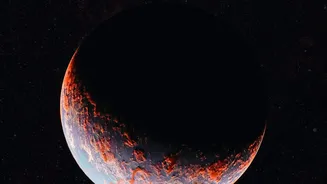
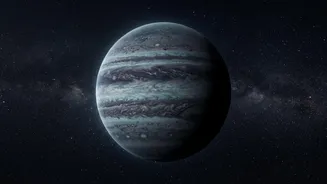
The planet at the center of this mystery, TOI-2535 b, is located about 1,000 light-years away. It's a type of world known as a 'hot Jupiter'—a gas giant similar in size to our own Jupiter, but orbiting perilously close to its parent star. TOI-2535 b completes a full orbit in just over eight days, a journey that takes Mercury in our solar system 88 days. TESS began observing this system in 2019, successfully detecting the planet's regular transits. For years, it was a routine, if fascinating, object of study. But then, things started to get weird. Astronomers noticed its transits were becoming erratic, sometimes arriving up to six hours early or late. And then, in March 2026, the transit signal vanished completely.
The Case of the Unseen Companion
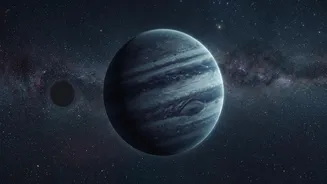
So, did the planet get destroyed or wander off into deep space? The reality, scientists say, is far more interesting. The planet hasn't gone anywhere. Instead, its orbit has. In a paper published in The Astrophysical Journal Letters, researchers led by a team at UCLA explained that TOI-2535 b is not alone. The erratic timing of its transits pointed to the gravitational pull of a second, unseen planet in the same system. The gravitational interaction between these two worlds is so strong that it is causing both of their orbits to wobble like a spinning top that is starting to tip over. This orbital wobble, known as precession, is what caused the 'disappearance'.
An Extreme Orbital Tilt
Over the seven years that TESS observed the system, astronomers watched as the planet’s transit path shifted. It started by crossing near the middle of its star, but with each passing year, its path moved closer to the star's edge until it was only creating a 'grazing' transit. Eventually, the tilt of its orbit shifted so much that, from our perspective, it no longer crosses the face of its star at all. The orbital plane has tilted out of our line of sight. According to researchers, this is the most extreme and fastest example of this phenomenon ever witnessed for a planet around a single star. 'The planet's orbit is tilting so quickly that its transit disappeared while we were watching', explained UCLA's Samuel Yee.
A New Cosmic Puzzle
This discovery provides a rare window into how planetary systems form and evolve. Hot Jupiters are already considered oddities because they are found so close to their stars, and they don't usually have massive neighbours that can affect their orbits so dramatically. The wobble of TOI-2535 b suggests that the planets in this system likely migrated slowly inward together, rather than one being violently thrown into a close orbit after a near-collision. This finding challenges existing theories and offers a new pathway for the formation of these extreme worlds. The 'disappearance' isn't an ending, but the beginning of a new chapter in understanding planetary dynamics. It turns an observational loss into crucial evidence about the hidden architecture of a distant solar system.