


Our Sun's Unseen Temper
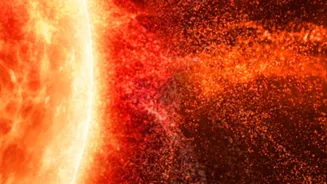
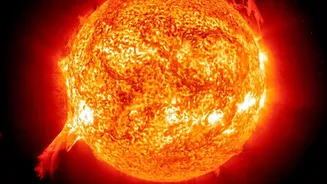
When we think of weather, we picture rain or sunshine. But there's another kind of weather that originates 93 million miles away: space weather. It’s driven by the Sun, which is not as calm as it appears. It constantly releases a stream of charged particles
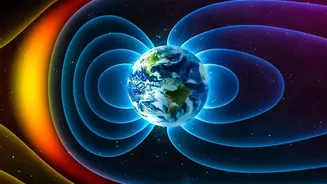
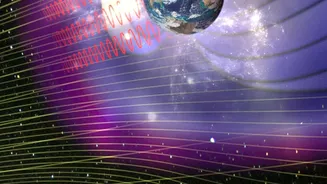
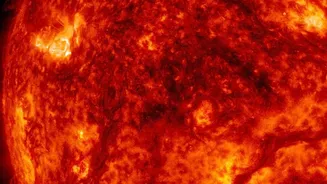
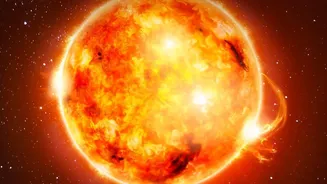
called the solar wind. Occasionally, it unleashes much more violent events, like solar flares (immense bursts of radiation) or coronal mass ejections (CMEs), which are giant clouds of solar plasma and magnetic fields hurled into space. When these events are aimed at Earth, they can cause significant disruptions to our magnetic field and upper atmosphere, creating what is known as a geomagnetic storm. While harmless to humans on the ground, these storms are a major hazard for our technology.
Satellites in the Firing Line
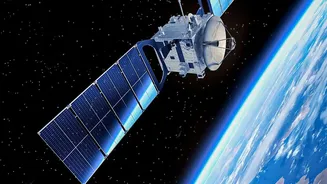
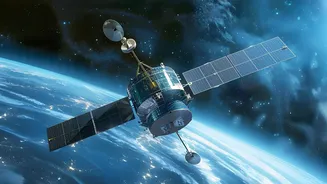
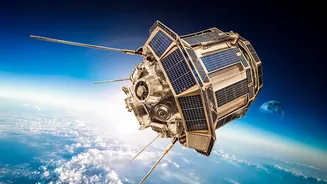
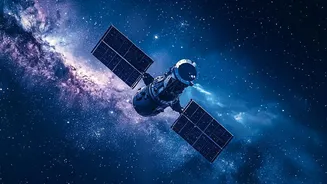
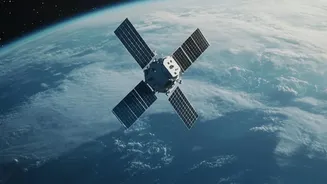
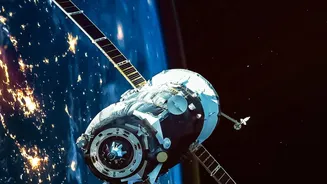
Satellites in low-Earth orbit are particularly vulnerable to space weather. One of the biggest problems is atmospheric drag. During a geomagnetic storm, the Earth's upper atmosphere heats up and expands, increasing its density. This thicker atmosphere creates more friction for satellites, slowing them down and causing their orbits to decay. If not corrected, this can lead to them falling out of orbit, as happened to a batch of Starlink satellites in 2022. Furthermore, the high-energy particles from a solar storm can fry sensitive electronics, disrupt communications, and corrupt GPS signals, making them unreliable. For a world reliant on precise timing and location data for everything from financial transactions to logistics, these impacts can have serious economic consequences.
The Challenge of Forecasting
Predicting space weather has been a major scientific challenge. For years, forecasts relied on spacecraft positioned about 1.5 million kilometres from Earth, which gave only about 15 to 60 minutes of warning for the fastest-moving storms. While helpful, this short lead time wasn't always enough for satellite operators to take protective measures. Early models could provide global predictions, but often without the necessary speed or precision. Others could give localized forecasts, but couldn't see the whole picture. The key has been to find a way to get faster, more accurate, and more localized warnings to the companies and agencies that need them most.
A New Era of AI-Powered Prediction
This is where a new generation of scientific tools comes in. Researchers, including international teams working with NASA and other institutions, have developed sophisticated models that use artificial intelligence to provide much better forecasts. One such model, called DAGGER, combines AI with real-time data from NASA satellites to predict the location and severity of a geomagnetic storm's impact anywhere on Earth with a 30-minute warning. Another AI model, named Surya after the Sanskrit word for the sun, was developed by NASA and IBM to analyze images of the sun and predict when and where a flare might erupt. These tools sift through vast amounts of data from solar observatories, identifying subtle patterns that precede solar events, offering a significant leap in predictive power.
Why Better Warnings Matter
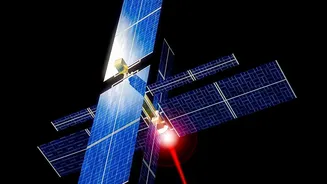
The development of these tools is more than an academic exercise; it's a critical upgrade for our global infrastructure. With more accurate and timely warnings, satellite operators can take action to protect their multi-million dollar assets. This might involve temporarily shutting down non-essential systems to prevent electrical damage or even adjusting a satellite's orbit to reduce drag. For businesses in India and across the globe, this means more reliable GPS for logistics and ride-sharing services, stabler satellite communications for broadcasting and banking, and the overall protection of a rapidly growing space economy. India's own lead author on the DAGGER model paper, Vishal Upendran, noted that this AI makes it possible to prevent or minimize devastation to modern society. As companies launch ever-larger constellations of satellites, these predictive capabilities will become an indispensable part of space traffic management.